
TL;DR — What You Need to Know About the Creator Economy
The creator economy is a $250 billion system where individual content makers try to convert attention into income through digital platforms. But here’s what most people miss: while attention has become abundant and easy to get, income remains scarce and difficult to capture.
The system has three parts:
- Creators produce content
- Platforms distribute it
- Money flows from multiple sources (brands, advertisers, audiences)
Platforms control the distribution infrastructure, which means they control who gets seen and who gets paid.
Here’s the part that trips people up: Most creator income doesn’t come from platform payments. Brand deals account for nearly 70% of creator revenue, while platform ad revenue makes up only 7%. That means if you’re optimizing for views and followers, you’re chasing the wrong thing. You need conversion systems, not vanity metrics.
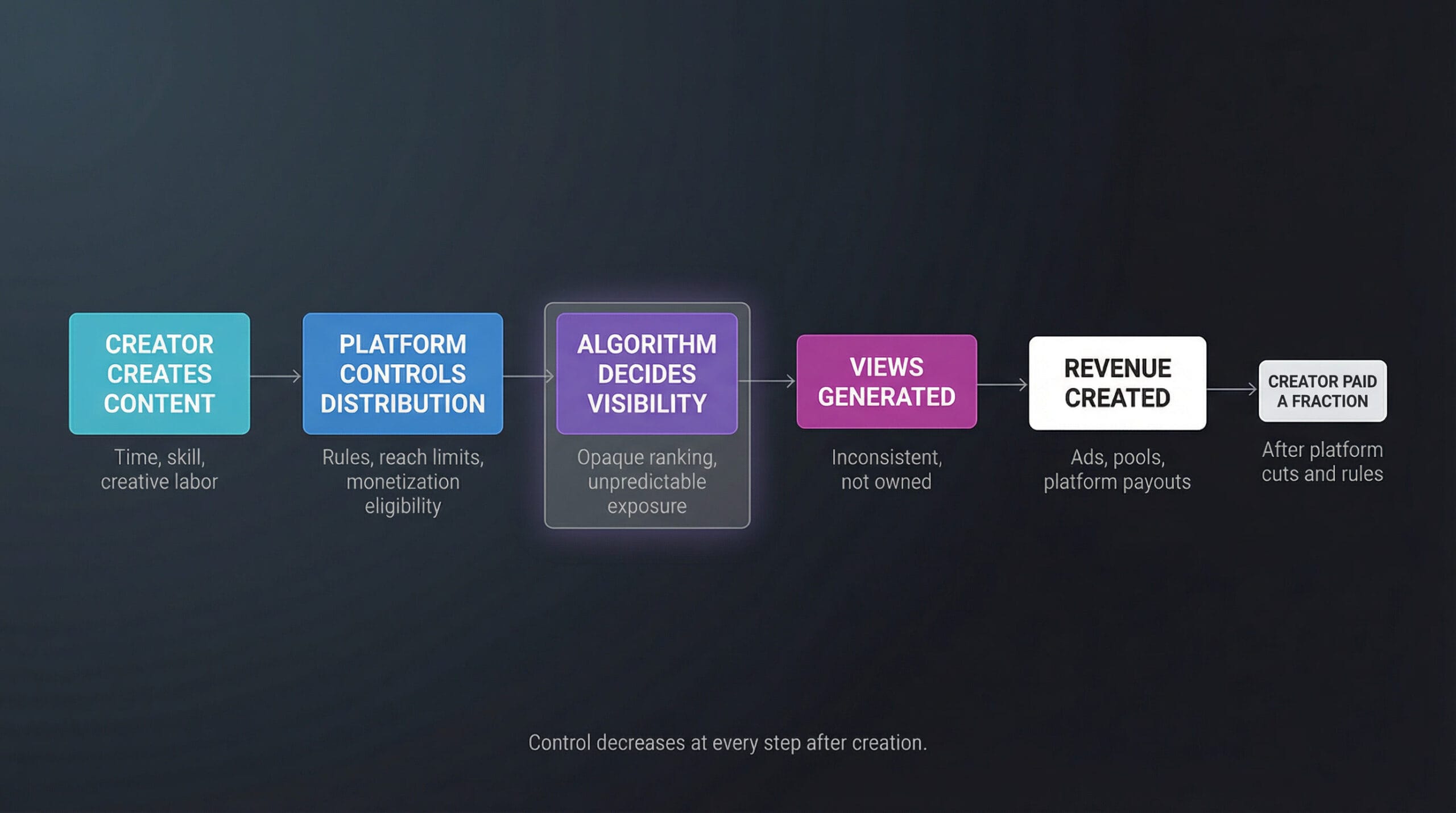
Algorithms determine visibility, and visibility determines income. When algorithmic distribution changes, income can drop overnight. Platform payments are intentionally low because platforms monetize attention at much higher rates than they pay creators.
Only 4% of creators earn more than $100,000 per year. The majority earn below minimum wage from their content. Success requires treating yourself as a business that happens to create content, not a content creator trying to stumble into business.
Understanding these mechanics helps you avoid wasting months or years chasing metrics that don’t convert to income.
The Three-Sided System: Creators, Platforms, and Money
The creator economy isn’t just “people making content online.” It’s a specific economic structure with three distinct participants, each optimizing for different outcomes. Once you see this structure clearly, the whole system makes more sense.
On one side, creators produce content. On another side, money sources (brands, advertisers, and audiences) want access to attention. Platforms sit in the middle as infrastructure providers, connecting the two sides.
This structure matters because it determines how power and value flow through the system.
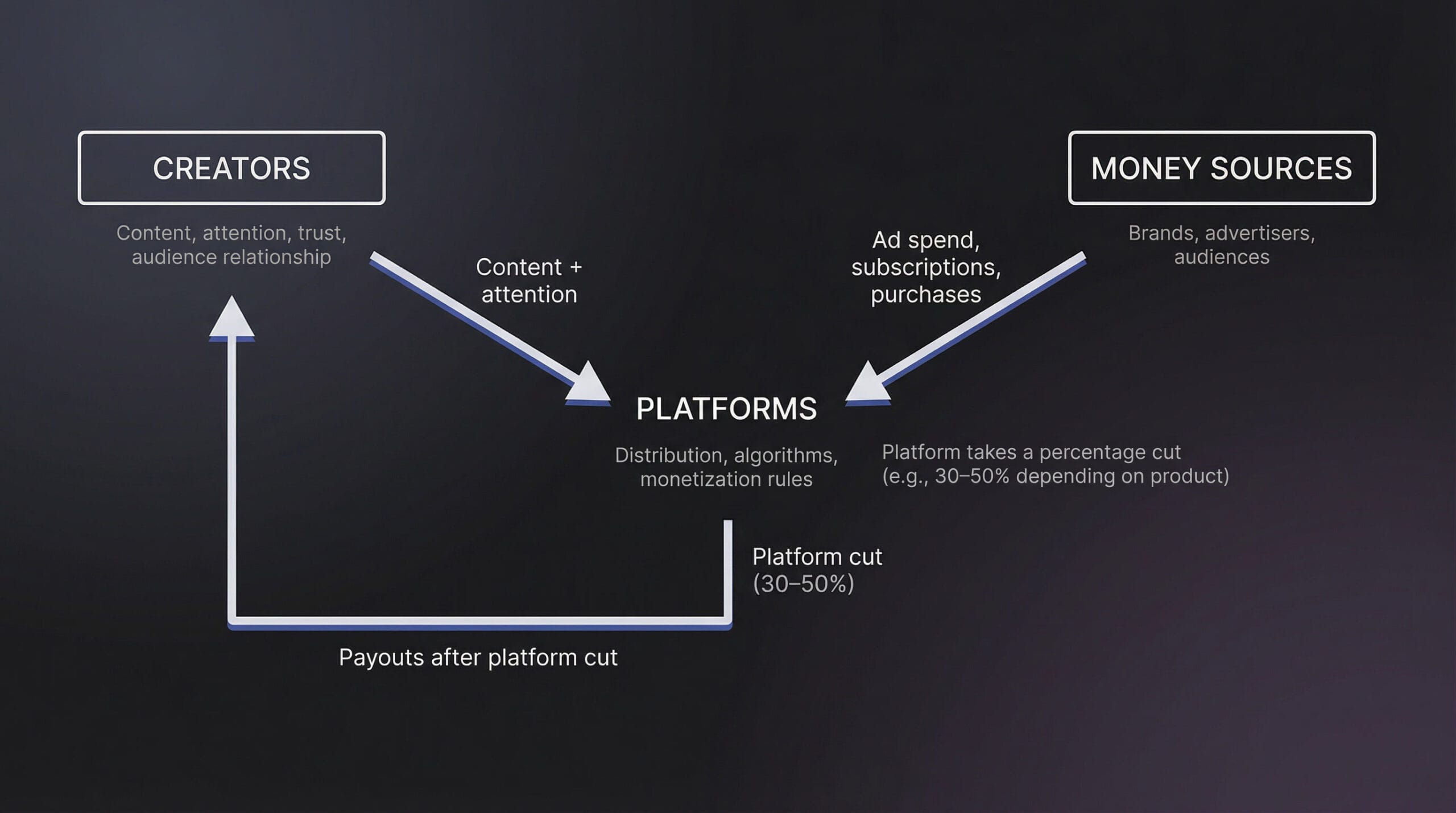
What Creators Actually Provide to the System
Creators serve two functions in this ecosystem:
1. Produce content that keeps users on platforms
2. Aggregate audiences that brands want to reach
Think of creators as content suppliers and audience aggregators. You’re not a customer of the platform, and you’re not a true partner. You’re the supply side of a two-sided marketplace.
Platforms need a constant flow of fresh content to keep users engaged, but they don’t need any specific creator. Individual creators are replaceable. The content supply itself is what matters to platform business models.
🚩 This is why platforms can change policies, alter algorithms, or reduce payments without warning. Losing one creator, or even a thousand creators, doesn’t threaten the platform’s core function as long as content keeps flowing.
What Platforms Extract and Why They Win
Platforms don’t create content. They create and control distribution infrastructure. Their business model is connecting content creators to audiences at scale.
Platforms monetize this connection in three primary ways:
- Advertising revenue from user attention
- Data collection about user behavior
- Transaction fees on commerce or payments
The key advantage platforms have is network effects. The more creators join, the more content exists. The more content exists, the more users visit. The more users visit, the more attractive the platform becomes to advertisers and new creators. This cycle compounds over time.
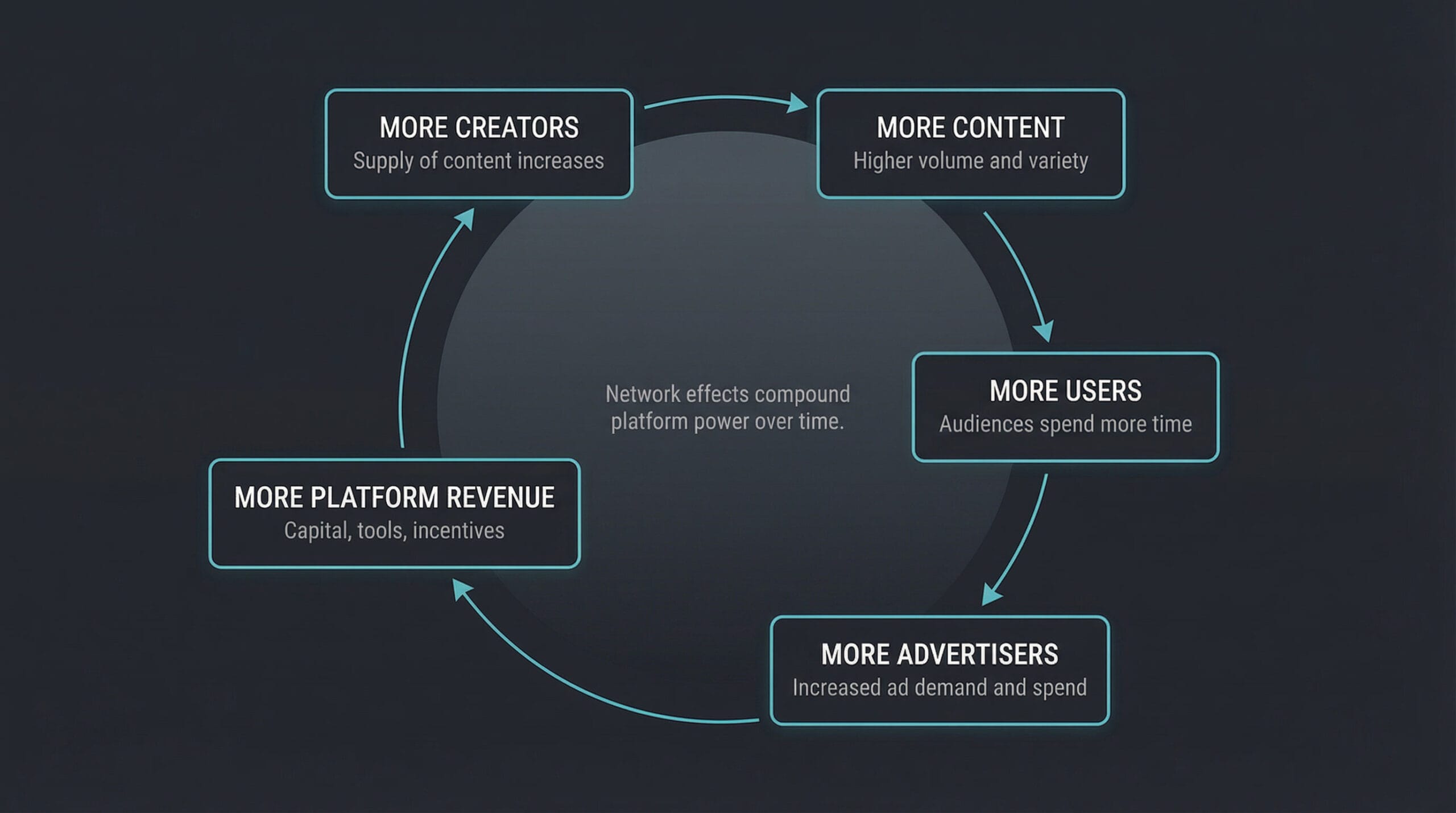
Platforms extract value by sitting between creators and audiences. They decide what gets seen through algorithmic distribution. They collect the majority of advertising revenue generated from creator content. They own the relationship with the end user.
When a brand pays to advertise next to creator content:
- Platform keeps: 50-70% of revenue
- Creator receives: 30-50% of revenue
When a creator earns money through platform programs, those payments come from a fraction of what the platform actually monetized from that creator’s audience.
Where the Money Enters (And Where It Gets Stuck)
Money enters the creator economy from four main sources:
| Source | % of Creator Income | Description |
|---|---|---|
| Brand deals | ~70% | Companies pay for access to audiences |
| Platform ad revenue | ~22% | Platforms share portion of ad revenue |
| Direct audience payments | ~13% | Subscriptions, memberships, tips |
| Product/service sales | ~30% | Creators sell their own offerings |
Note: Percentages overlap because many creators use multiple revenue streams
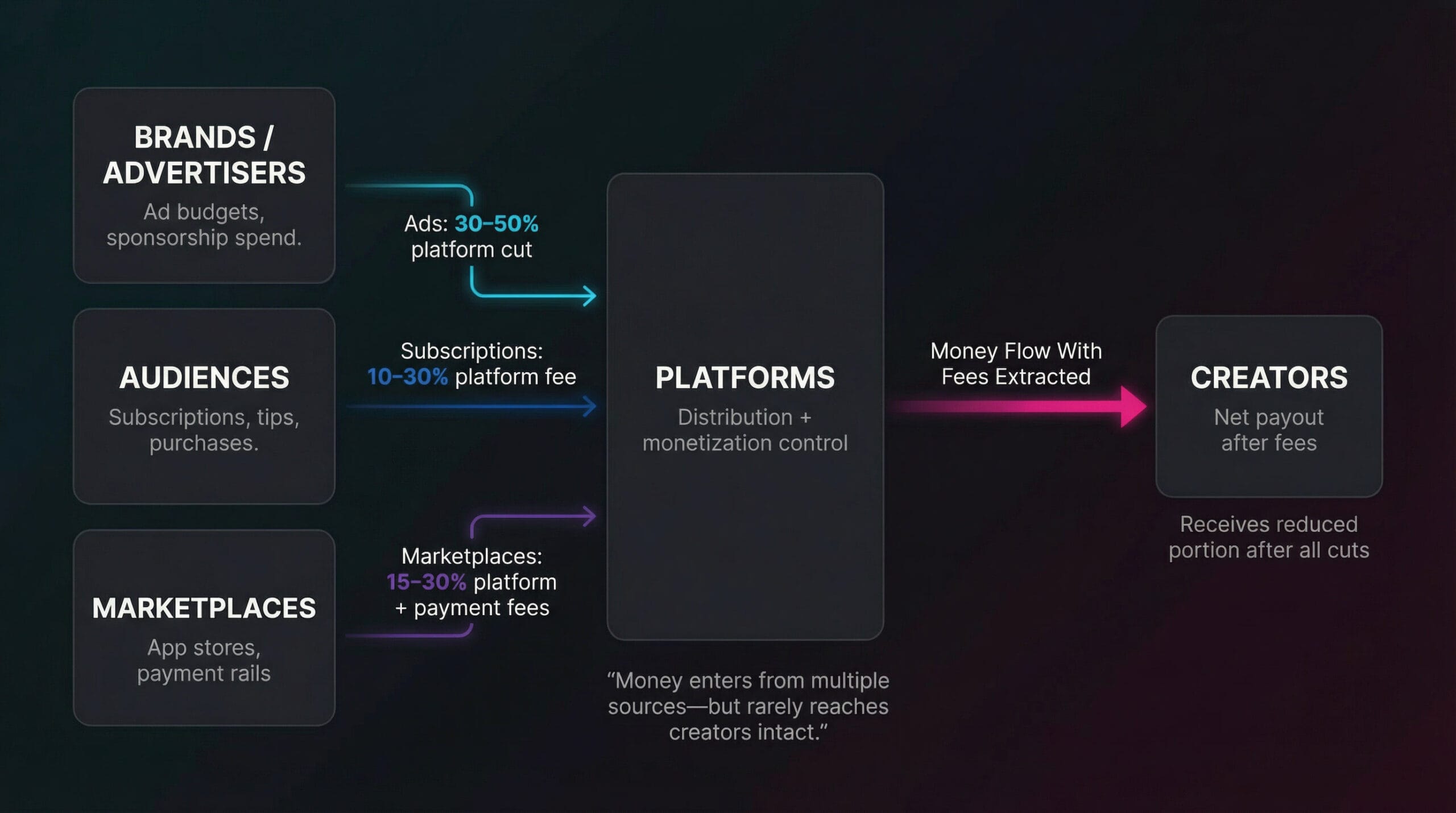
Here’s where money gets stuck: Platforms sit between most of these flows and extract fees.
- Brand pays creator through platform program → Platform takes cut
- Audiences pay through platform subscription → Platform takes 15-50%
- Transactions happen on platform → Platform takes payment processing fees
The only money that bypasses platforms entirely is when creators negotiate direct brand deals outside platform systems or sell products through their own infrastructure. This is why the highest-earning creators diversify away from platform-dependent revenue streams.
Why Everyone Has Attention But Almost No One Has Income
Two decades ago, attention was scarce. A limited number of television channels, radio stations, and publications controlled what people consumed. Getting attention meant getting past gatekeepers who controlled distribution.
The internet changed the fundamental economics. Now anyone can publish content instantly to global audiences at near-zero cost. Content supply became infinite.
When supply becomes infinite and demand stays relatively constant, the price of the commodity (in this case, attention) collapses toward zero.
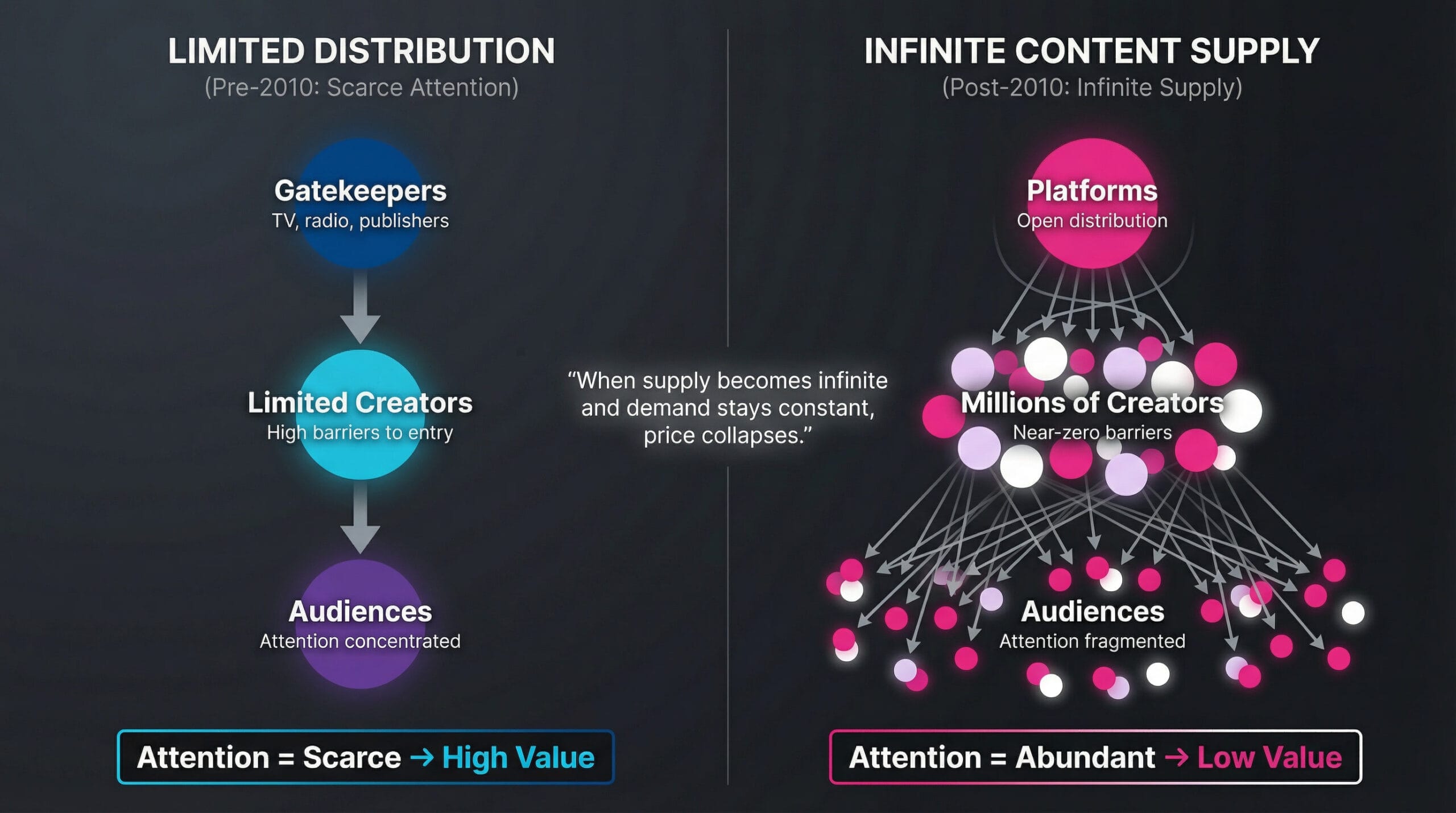
How Infinite Content Made Attention Worthless
Before digital platforms, creating and distributing content required significant capital investment. You needed printing presses, broadcast licenses, or physical distribution networks. These barriers limited supply.
Platforms removed those barriers. Now the cost of creating and distributing content is essentially zero. Anyone with a smartphone can produce and publish video, text, images, or audio to billions of potential viewers.
This abundance fundamentally changed the value equation. When there are millions of videos competing for the same viewer’s time, each individual view becomes less valuable.
The platform benefits from this abundance. More content means more engagement overall. But individual creators don’t benefit from competition with infinite alternatives.
Think of it this way:
- Platforms monetize aggregate attention (don’t care which video someone watches)
- Creators need their specific content to be seen
This creates an asymmetric value capture. Platforms win from attention abundance. Creators lose from the same dynamic.
The Brutal Conversion Math: Views to Dollars
The gap between attention metrics and actual income is where most creator aspirations die. Let me show you the actual numbers.
Platform Payment Reality:
| Platform | Pay Per 1,000 Views | 1 Million Views = | 10 Million Views = |
|---|---|---|---|
| TikTok | $0.40 – $1.00 | $400 – $1,000 | $4,000 – $10,000 |
| YouTube | $2.00 – $5.00 | $2,000 – $5,000 | $20,000 – $50,000 |
| $0 (no revenue share) | $0 | $0 |
High-value niches (finance, technology) might reach $10-$15 per 1,000 views on YouTube, but these are exceptions.
Real-world example:
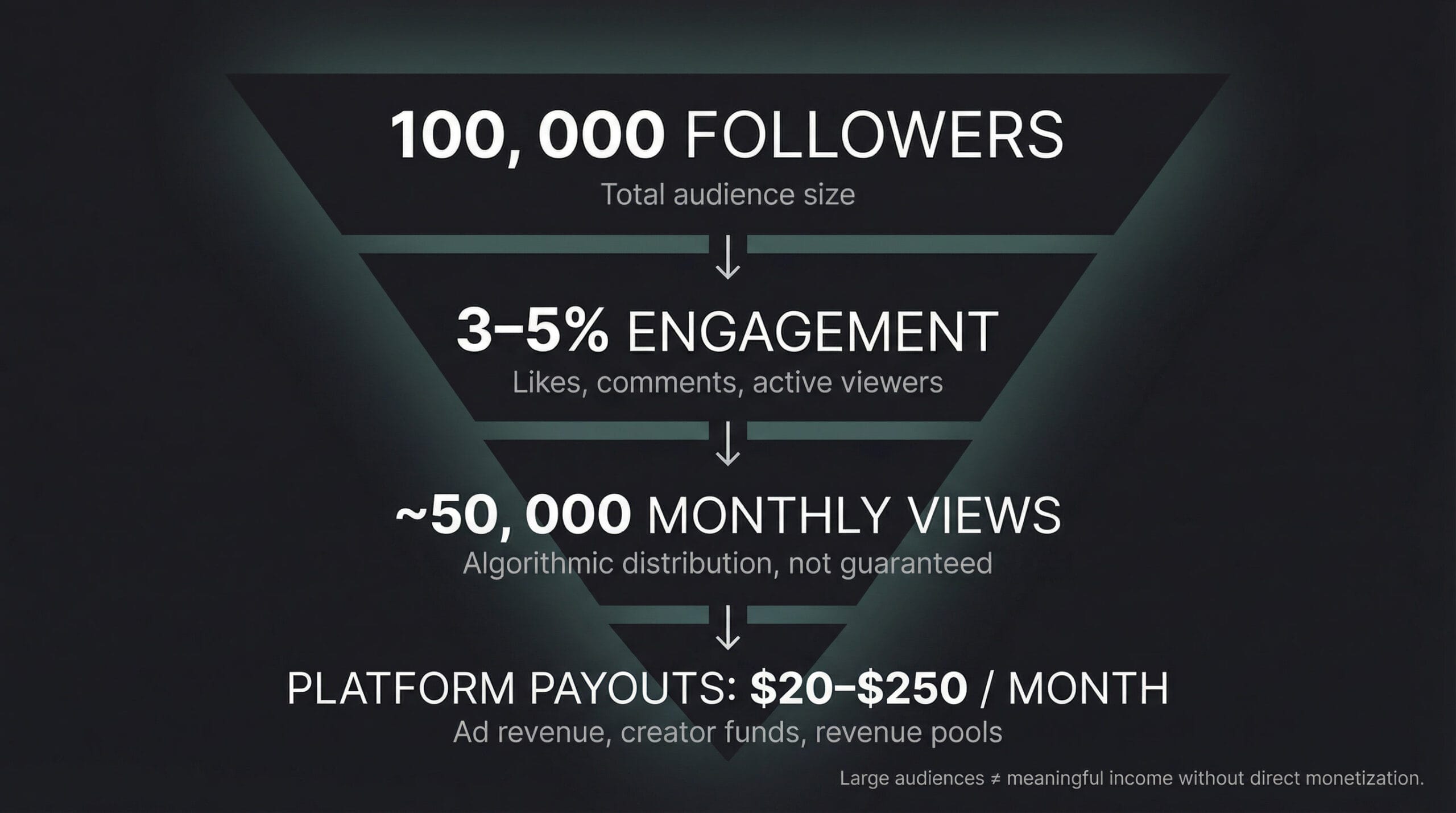
A creator with 100,000 followers might average 3-5% engagement rate = 3,000-5,000 people see each post.
If posts generate 50,000 views per month total:
- TikTok earnings: $20-$50/month
- YouTube earnings: $100-$250/month
This is why:
- 73% of creators earn less than $30,000/year
- 57% of full-time creators earn below U.S. living wage (~$44,000)
Here’s what this means for you: The conversion from attention to income requires additional steps beyond views. You need audience trust, conversion systems, offers people actually want to buy, and infrastructure to deliver value.
Most creators stop at “getting views” and wonder why they’re broke. Attention is the raw material, not the finished product. Raw materials without processing infrastructure generate minimal value.
The Four Real Ways Creators Get Paid (And Why Most Use Only Two)
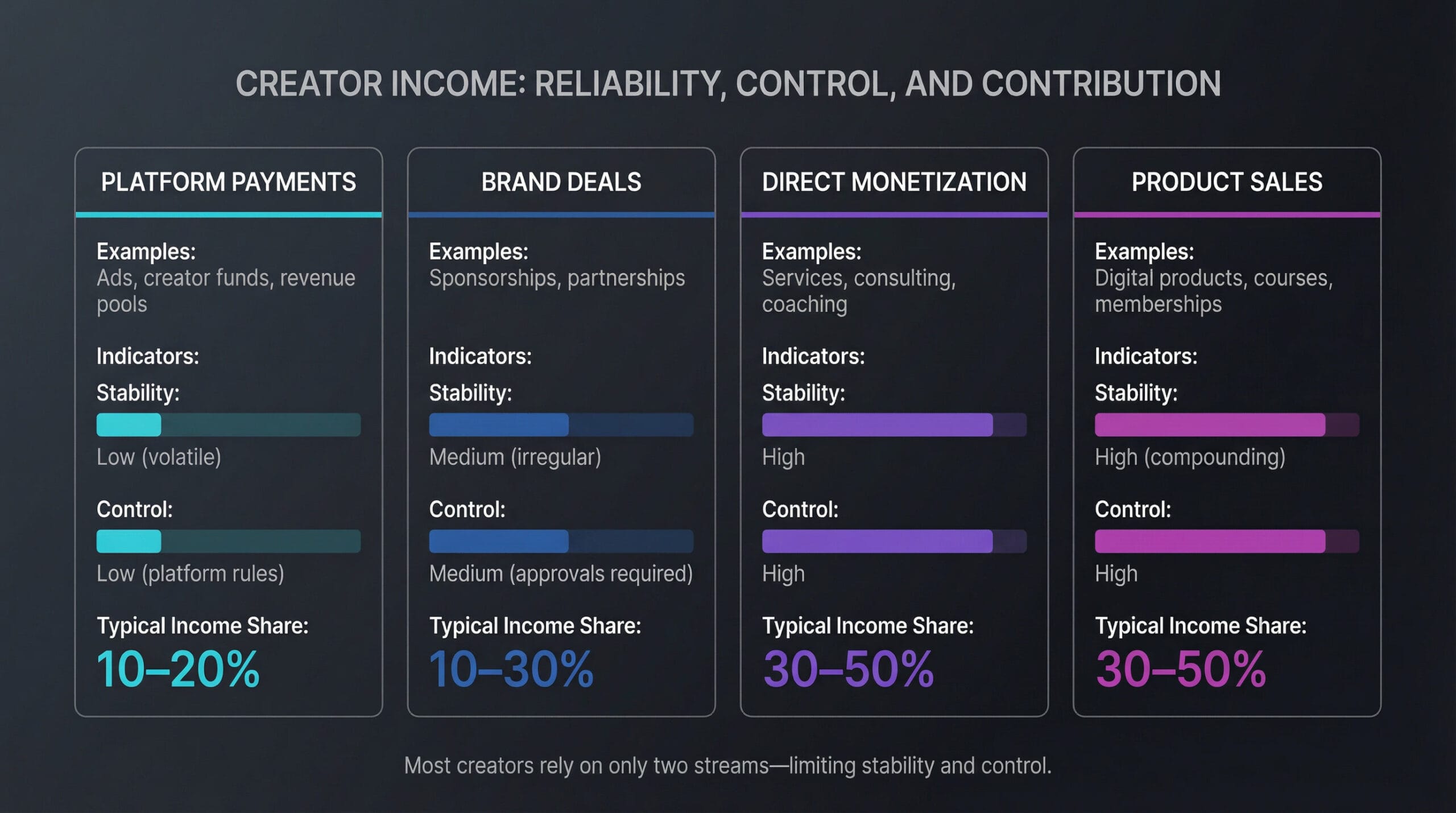
Creator monetization isn’t mysterious, but it’s more concentrated than most people realize. Nearly all creator income flows through four channels, and the vast majority of creators rely heavily on just one or two of them.
Understanding which revenue streams actually work (and why most creators can’t diversify effectively) prevents years of wasted effort on broken models.
Platform Revenue: Renting Someone Else’s Infrastructure
Platform payments are the most visible monetization method, but they’re also the least reliable and lowest paying for most creators.
This category includes:
- Ad revenue sharing on YouTube
- Creator funds on TikTok
- Subscription features (YouTube memberships, Twitch subscriptions)
- Tipping systems during live streams
🚩 The fundamental problem: The platform controls eligibility requirements, payment rates, and distribution. All three can change at any time without warning.
TikTok’s Creator Fund example:
- Original fund: $0.02-$0.04 per 1,000 views
- Replacement program pays slightly better but still far below what platform earns
YouTube’s Partner Program:
- Requirements: 1,000 subscribers + 4,000 watch hours
- Creator share: 55% of ad revenue
- Actual earnings: Most creators average $2-$5 per 1,000 views
Real-world impact: When YouTube adjusted its algorithm to favor Shorts over long-form content, many creators saw ad revenue drop 30-50% overnight despite posting the same amount of content.
✅ Platform revenue works as: Supplemental income
❌ Platform revenue fails as: Primary income source
The appeal is that it feels passive. Upload content, earn money automatically. The reality is that it’s highly active (requiring constant content production) while being completely outside your control.
I’d avoid relying on platform revenue for more than 20-30% of your total income unless you have massive scale.
Brand Deals: Selling Access to Your Audience
Brand partnerships account for approximately 70% of creator revenue, making them the dominant monetization method by a significant margin.
This includes:
- Sponsored content (brands pay for dedicated posts)
- Product integrations (featuring products in regular content)
- Affiliate relationships (earning commissions)
- Long-term ambassador programs
The massive payment difference:
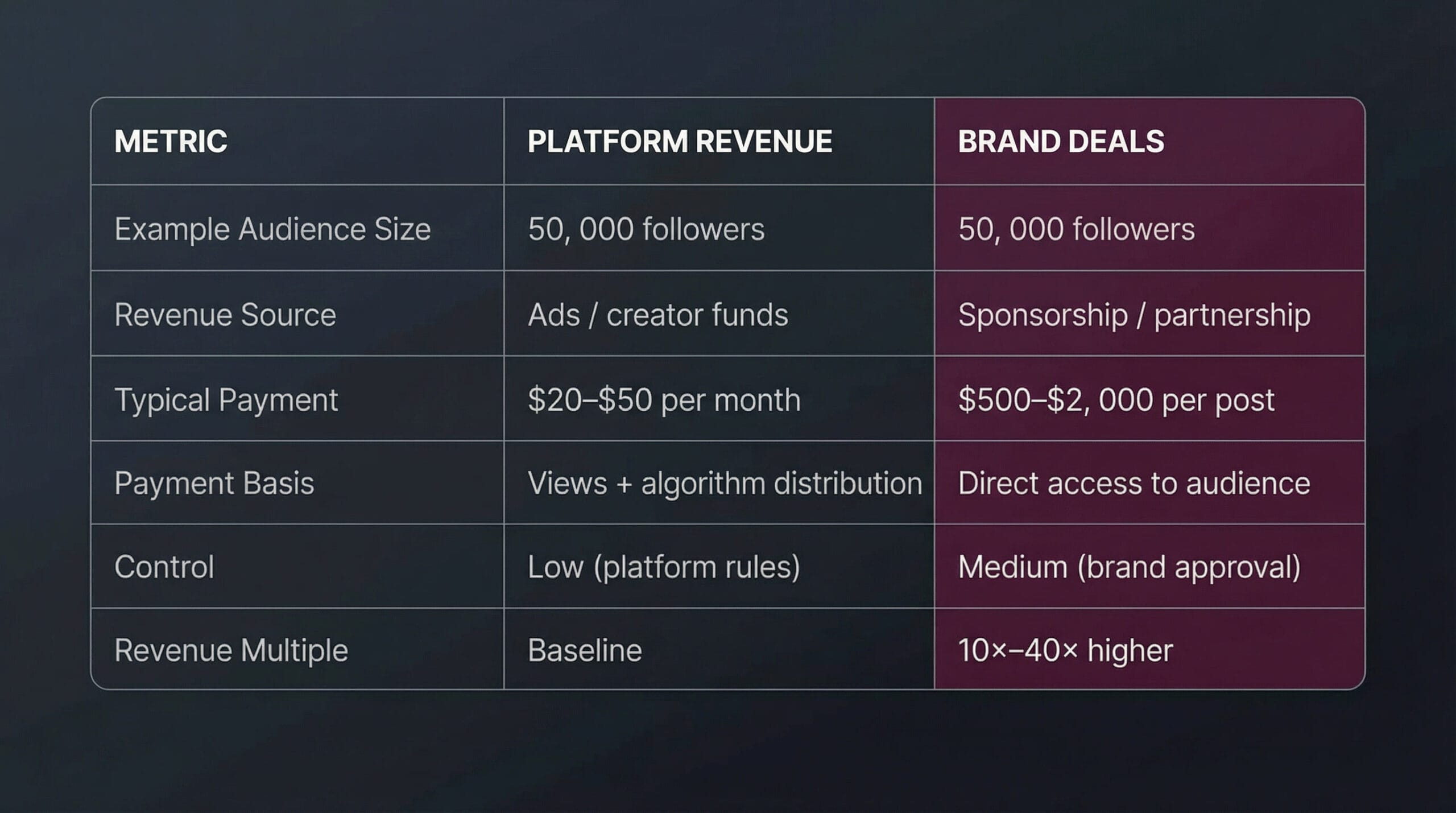
A creator with 50,000 engaged followers:
- Brand deal payment: $500-$2,000 per sponsored post
- Platform ad revenue: $20-$50 for the same post
Why the 10-40x difference? Brands aren’t paying for content. They’re paying for distribution access. They want to reach your specific audience with messaging that feels authentic rather than like traditional advertising.
Here’s where most people get this wrong: They think bigger audience = more money. Not true. A creator with 10,000 highly engaged followers in a valuable niche (finance, B2B software) can charge more per post than a creator with 100,000 unengaged followers in a saturated niche.
Real earnings breakdown:
Creators earning $50,000-$100,000/year typically achieve this through:
- 10-20 brand deals annually
- $2,500-$5,000 per deal
- NOT through platform payments
❌ The downside: Unpredictability
- Brand budgets fluctuate with economic conditions
- Campaign frequency varies
- Requires time and business skills for negotiating, pitching, and managing partnerships
Direct Monetization: Building Your Own Income Engine
Direct audience payments represent the smallest share of creator revenue but the highest level of control.
This includes:
- Patreon or similar subscription platforms
- Paid newsletters on Substack
- Membership programs
- Premium content tiers
- Digital products (courses, ebooks)
- Physical products (merchandise)
The fundamental difference: Ownership. You’re not renting distribution from a platform or selling access to brands. You’re building direct relationships with people who value what you create enough to pay for it.
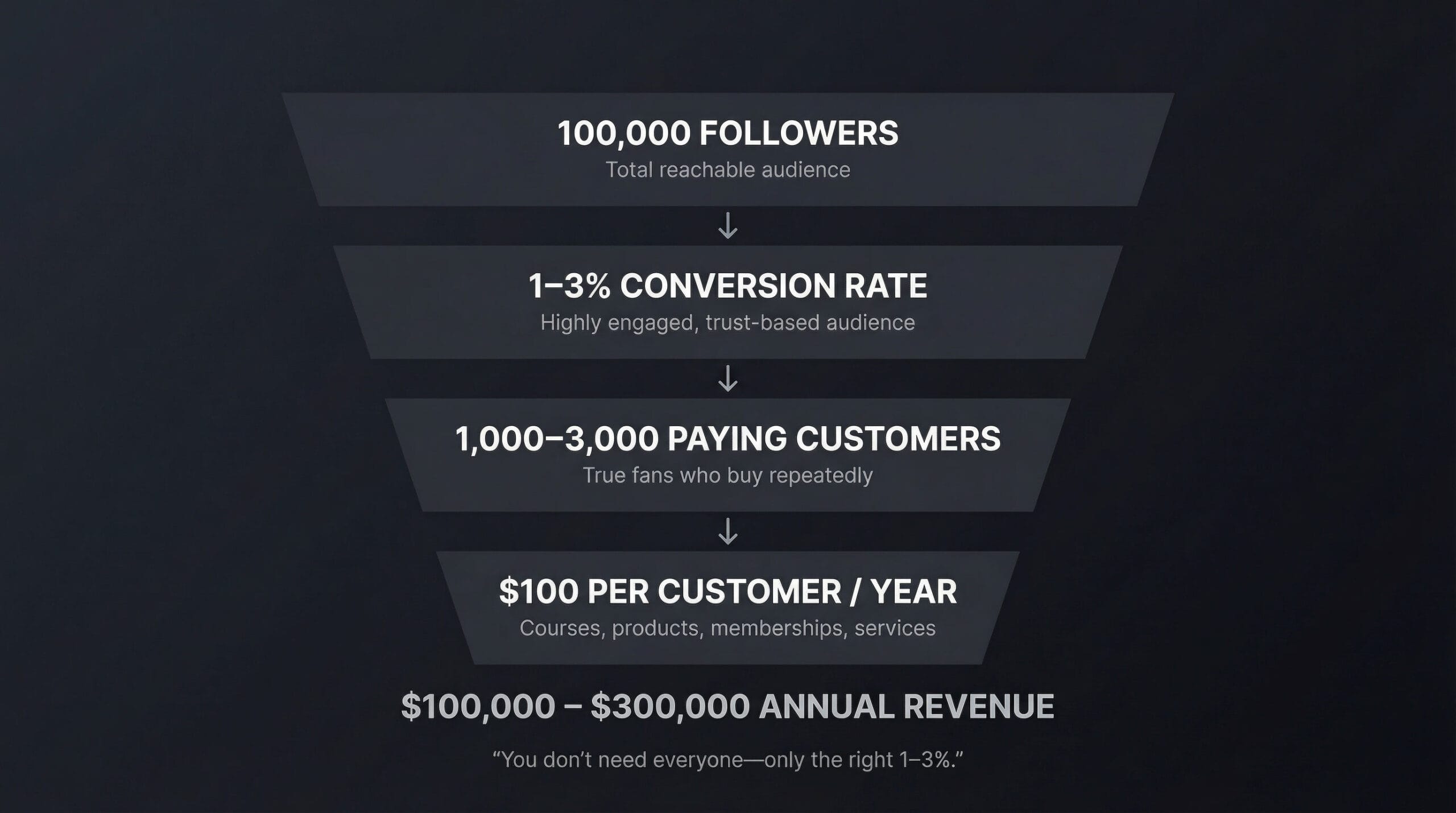
The “1,000 True Fans” math:
1,000 people paying $100/year each = $100,000 annual revenue
The challenge: Conversion rates
Most creators see conversion rates of 1-3% from audience to paying customers.
This means:
- Need 30,000-100,000 engaged followers
- To generate 300-3,000 paying customers
- Building that audience size takes 2-3 years for most
✅ The upside:
- Stability and scalability
- Subscription revenue is predictable
- Digital products can sell while you sleep
- Not dependent on algorithm changes or brand budget cycles
Top-earning creators almost always have direct monetization as 40-60% of total revenue. But they typically build this after establishing themselves through platform revenue and brand deals first, because direct monetization requires existing trust and audience size.
If you’re just starting, here’s what I’d do:
1. Platform revenue first (lowest effort, proves concept)
2. Brand deals second (highest short-term income)
3. Direct monetization third (highest long-term stability)
Don’t try to build all three simultaneously. You’ll fail at everything.
How Platforms Really Make Money (And Why You’re the Product)
Understanding platform business models explains why platforms make decisions that seem to hurt creators. These aren’t mistakes or oversights. They’re intentional features of how platforms generate revenue.
Platform companies don’t create content. They create infrastructure that connects content creators to audiences, then monetize that connection in ways that prioritize platform profit over creator income.
The Attention Arbitrage Business Model
Platforms operate on attention arbitrage. They acquire attention at one price and sell it at a higher price, keeping the difference.
Here’s how it works:
Step 1: Platforms pay creators a small percentage of ad revenue (or nothing) to produce content
Step 2: That content generates user engagement
Step 3: Platforms sell that user attention to advertisers at much higher rates
YouTube example:
A video generates $100 in ad revenue:
- Creator receives: $55 (55%)
- Platform keeps: $45 (45%)
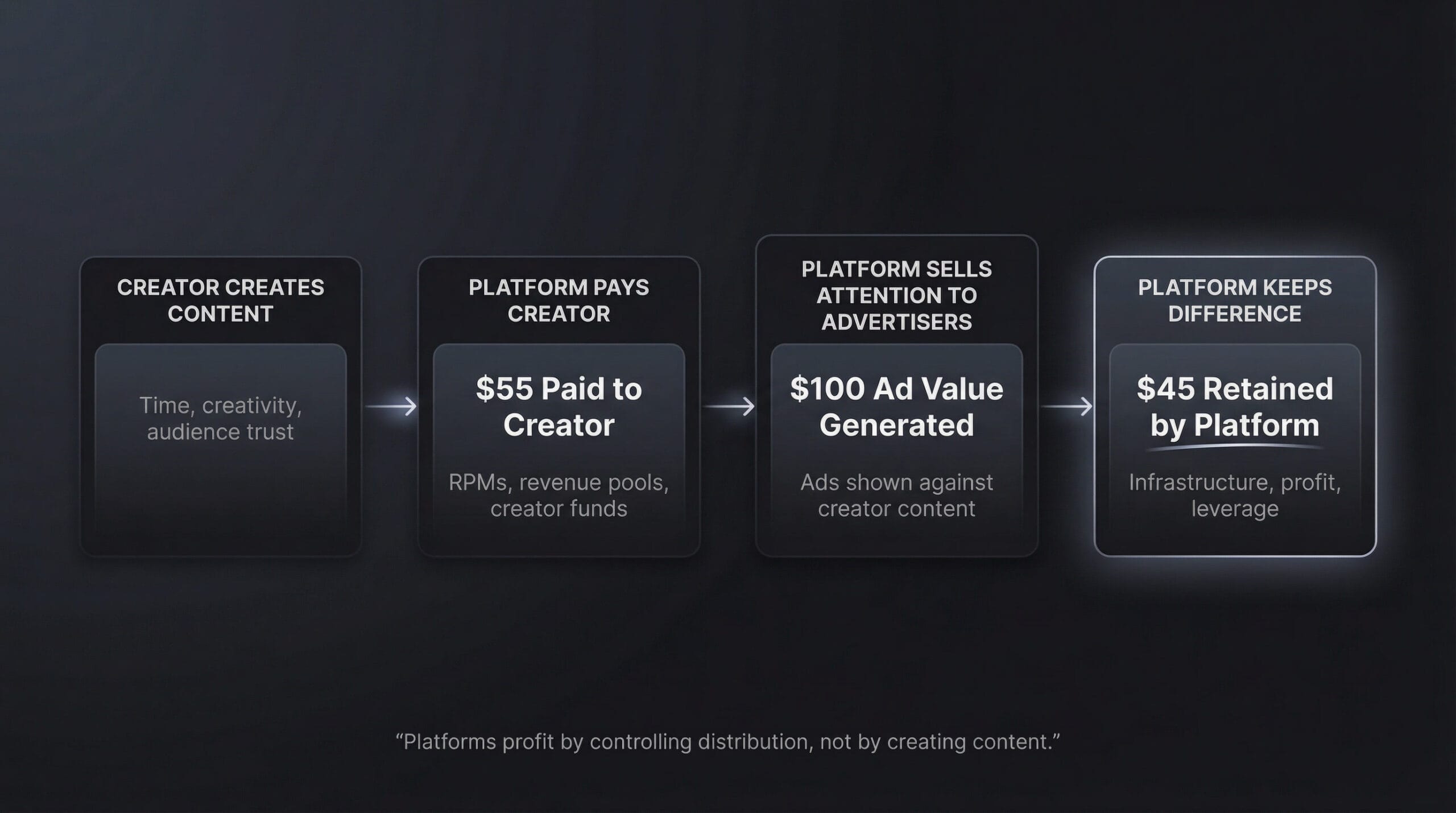
The platform provided distribution infrastructure. The creator provided the content, production, editing, and audience relationship.
Other platforms are less generous:
| Platform | Creator Share | Platform Take |
|---|---|---|
| YouTube | 55% | 45% |
| TikTok Creator Fund | <5% | >95% |
| 0% (no revenue share for most) | 100% |
The arbitrage exists because platforms control distribution. Without the platform’s algorithm promoting content, creators can’t reach audiences at scale. This distribution control lets platforms dictate payment terms.
Platforms also monetize without paying creators:
- Selling user data to advertisers for targeting
- Charging businesses for promoted posts and ads
- Taking transaction fees on commerce
- Selling premium features and subscriptions to users
Bottom line: The business model is acquiring content supply cheaply from creators, using that content to generate user engagement, then monetizing that engagement at rates much higher than what you pay content suppliers.
This isn’t evil. It’s just business. But you need to understand it so you stop expecting platforms to care about your income.
Why Platforms Can Afford to Lose You
Individual creators have almost zero leverage in platform relationships because creators are interchangeable from the platform’s perspective.
Platforms need content, but they don’t need your specific content. As long as enough creators produce enough content to keep users engaged, the platform functions fine.
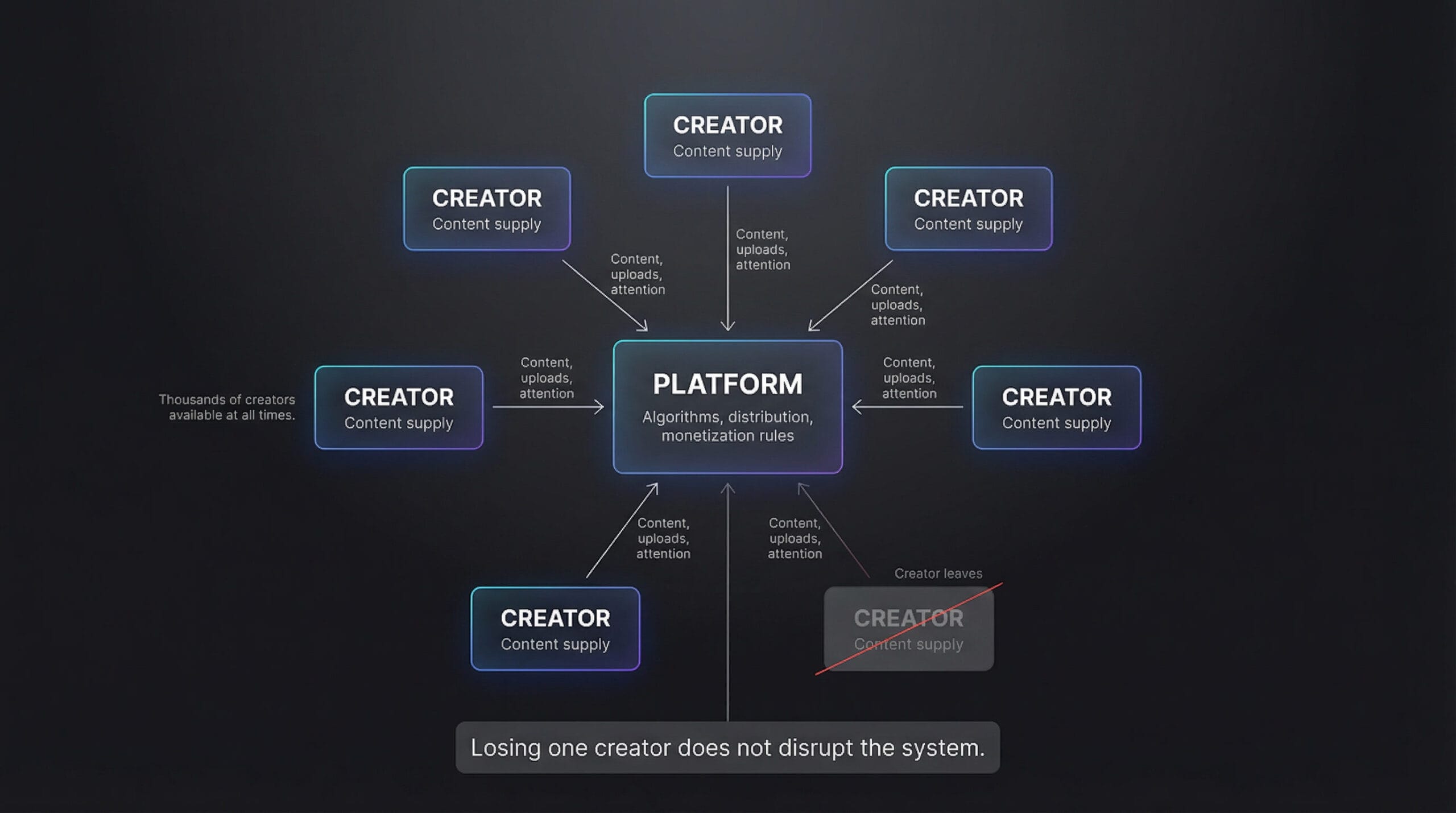
This is why platforms can:
- ❌ Change payment terms without negotiation
- ❌ Alter algorithms that cut your reach by 50% overnight
- ❌ Add new content formats that cannibalize your traffic
- ❌ Suspend or ban accounts with minimal recourse
- ❌ Implement new policies that disadvantage your content type
If you leave or quit, someone else fills the content gap. The platform’s core asset is the distribution network and user base, not the creator relationships.
Real-world example:
When YouTube shifted to favor Shorts, long-form creators saw massive traffic declines:
- Many complained
- Some quit
- YouTube didn’t reverse the change
Why? Aggregate user engagement increased, even though individual creator income dropped.
When TikTok adjusted its Creator Fund to pay less:
- Thousands of creators protested
- Platform eventually replaced it with slightly better program
- Fundamental economics didn’t change
The only creators with leverage: Those large enough that losing them would impact platform metrics. Think creators with 5+ million highly engaged followers. Everyone else is replaceable.
🚩 This explains why building platform-independent audience assets matters. Email lists, owned communities, and direct customer relationships can’t be taken away by algorithm changes or platform policy updates.
Algorithms Decide Who Gets Seen (Which Decides Who Gets Paid)
Algorithmic distribution is the single most important factor determining creator income, yet it’s the least controllable. Understanding how algorithms work and what they optimize for prevents wasted effort on strategies that can’t succeed.
What “The Algorithm” Actually Optimizes For
Algorithms aren’t neutral content discovery systems. They’re optimization engines designed to maximize specific platform goals.
The primary goal: User retention time
Platforms make money when users stay on the platform, so algorithms prioritize content that keeps people engaged longer.
Secondary goals:
- Maximizing session length (how long someone uses the platform in one sitting)
- Increasing session frequency (how often someone returns)
- Preventing user churn (keeping people from leaving permanently)
- Driving specific actions (comments, shares, follows)
Notice what’s missing:
- ❌ Creator income
- ❌ Content quality
- ❌ Fairness
- ❌ Consistency
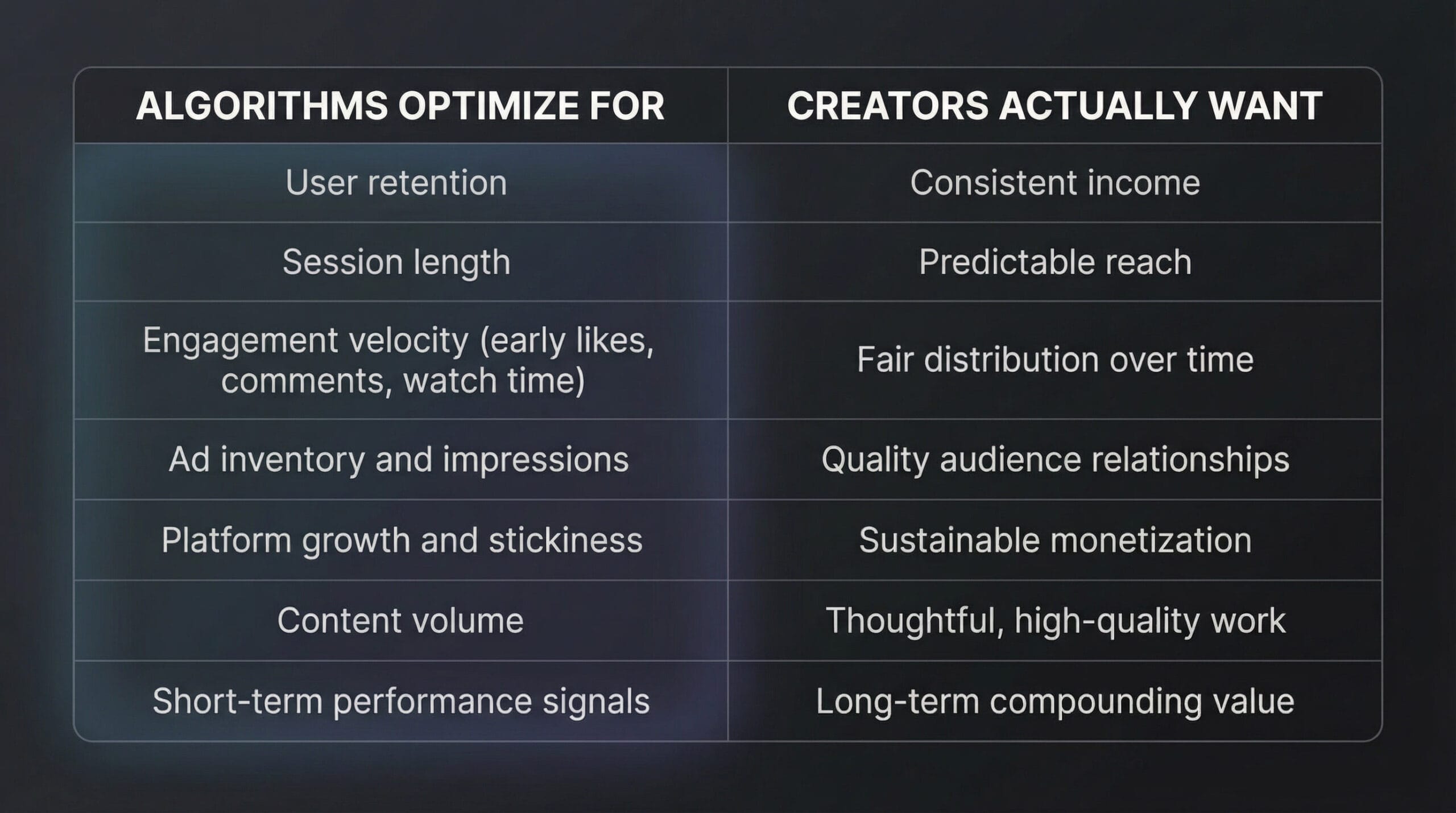
Algorithms measure success through engagement signals:
- Watch time
- Completion rate
- Likes
- Comments
- Shares
- Saves
- Follows
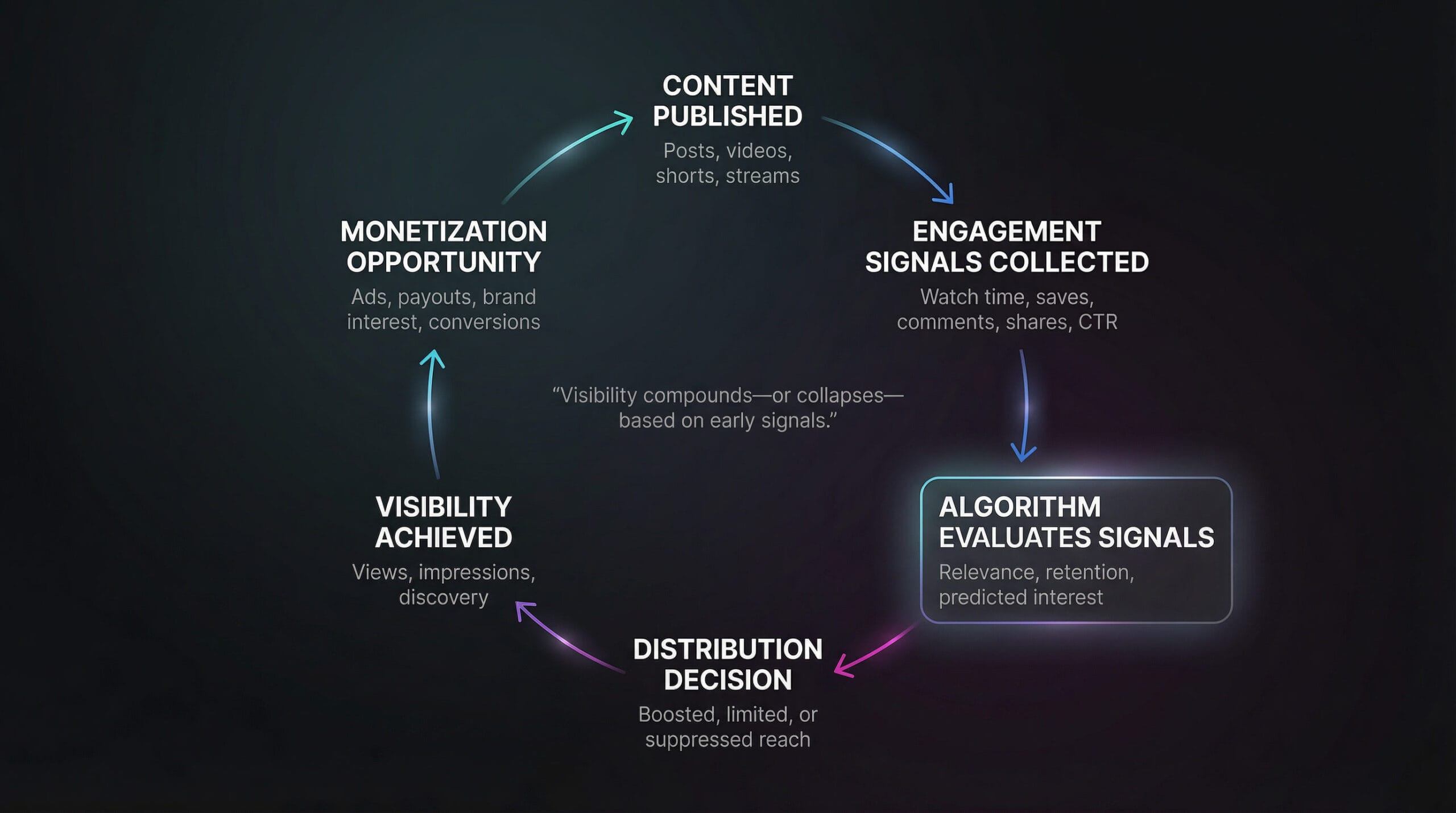
Content that generates these signals gets distributed more widely. Content that doesn’t gets buried.
This creates a fundamental misalignment: Creators want consistent income. Algorithms want maximum engagement. These goals often conflict.
Example:
Educational content that solves a problem completely might get low repeat viewership because viewers don’t need to watch again.
Entertainment content that leaves people wanting more generates higher engagement metrics but potentially less actual value.
The algorithm rewards the second type regardless of quality because it optimizes for platform metrics, not viewer benefit or creator sustainability.
Research with creators shows they describe algorithms as “opaque,” “unpredictable,” and “controlling.” They’re forced to “play the visibility game.” Creating content that appeals to algorithmic preferences rather than what they think is best or most valuable.
🚩 This is intentional. Platforms benefit from keeping algorithmic operations opaque because it prevents gaming while maintaining creator dependence on the platform for distribution.
Why Viral Success Doesn’t Create Business Stability
Going viral feels like success, but it’s usually the opposite of building a sustainable creator business.
Viral content generates:
- Massive temporary attention
- Without infrastructure to capture lasting value
A video that gets 10 million views might:
- Earn $4,000-$10,000 in platform revenue
- Generate brand deal inquiries worth $5,000-$15,000
- Create temporary follower surge
Within 60 days, most viral creators see:
- 90%+ audience drop-off
- New followers came for viral content, not the creator
- When subsequent content doesn’t match viral hit’s appeal, they stop engaging
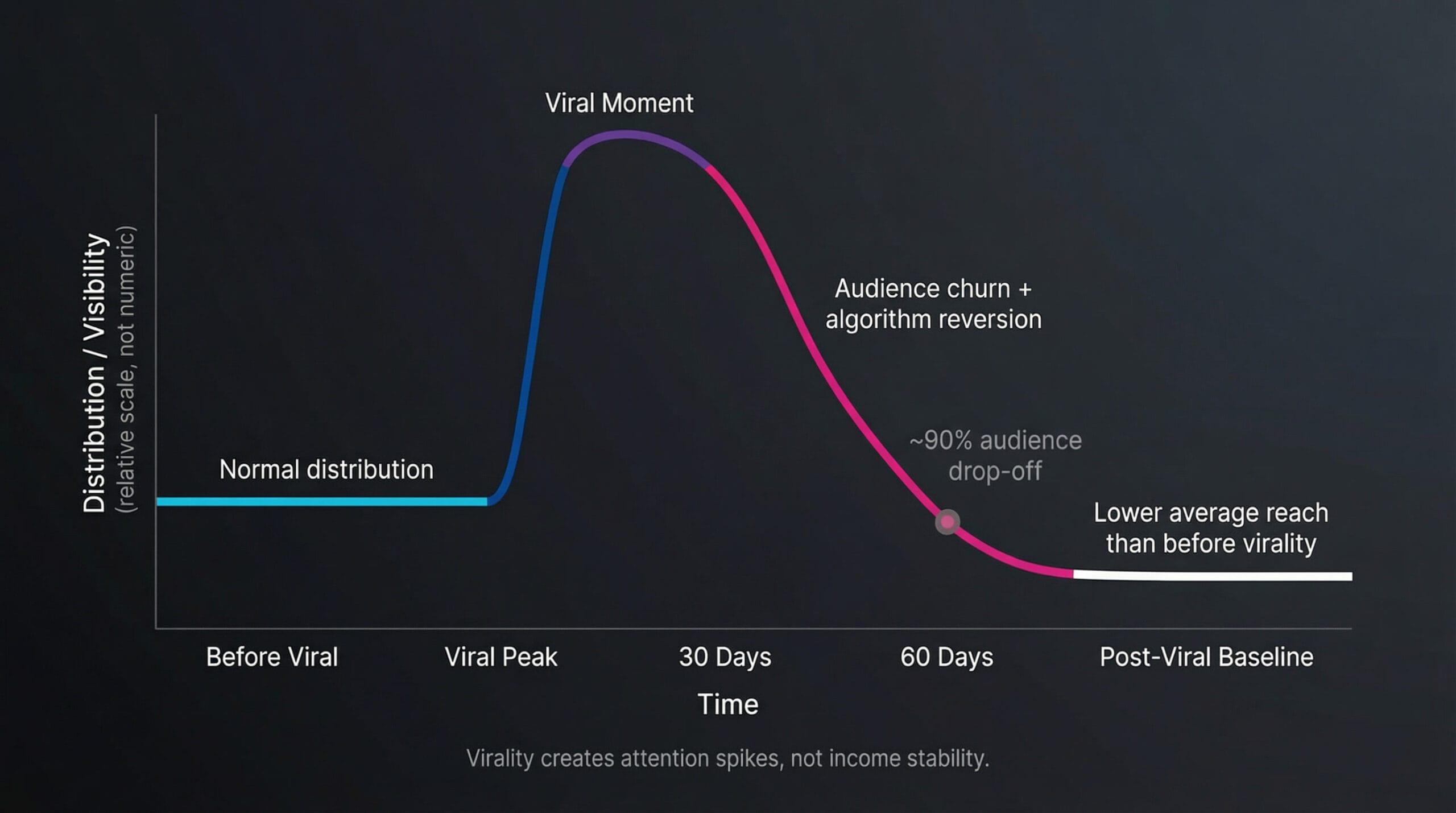
The algorithmic feedback loop makes this worse:
After viral success, the algorithm tests your next content against the viral performance. When it underperforms (which it almost always does), distribution drops below your pre-viral baseline.
Creators describe this as being “punished by the algorithm” after going viral, but the algorithm is just doing what it’s designed to do. Optimizing for engagement. The viral content set an impossibly high benchmark.
Sustainable creator businesses build:
- ✅ Consistent audience relationships
- ✅ Predictable content quality
- ✅ Conversion systems that turn attention into multiple revenue streams
Viral content rarely includes any of these elements.
The creators who successfully leverage viral moments are those who already have business infrastructure in place:
- Email list capture systems
- Clear value propositions
- Offers ready to sell
- Conversion funnels built
They use the temporary attention boost to fill their owned audience assets. Most creators who go viral have none of this. They get attention without the ability to convert it, then watch it evaporate.
The Seven Mistakes That Keep Creators Broke
Most creator failures follow predictable patterns. These mistakes are structural, not motivational. Understanding them prevents years of wasted effort.
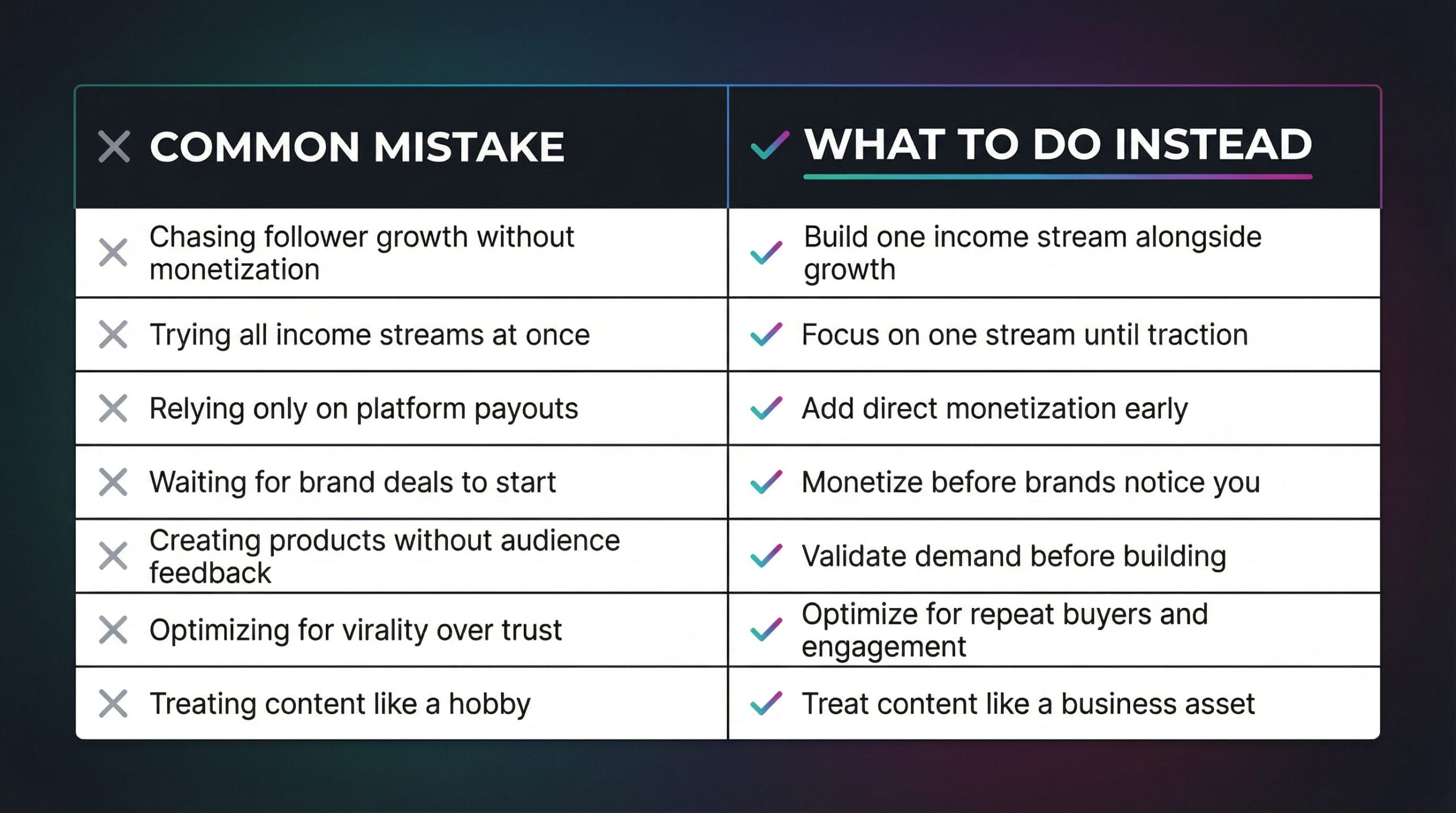
❌ Mistake #1: Optimizing for Views and Followers Instead of Conversion and Income
Views and followers are vanity metrics. They measure attention, not value capture.
A creator with 100,000 followers generating zero income has built an impressive-looking failure.
The optimization trap happens because views and followers are:
- Visible
- Measurable
- Socially validating
Income is private and harder to achieve. So creators chase the metrics that feel like progress without building systems that generate actual revenue.
✅ The fix: Reverse the priority
- Design for conversion first
- Then use content to drive that conversion
- Ask “how does this content lead to income?” before “how do I get more views?”
❌ Mistake #2: Building Entirely on Platform-Controlled Distribution
Building 100% on rented land means your business can disappear overnight through no fault of your own.
What can eliminate your income instantly:
- Algorithm changes
- Policy updates
- Account suspensions
- Platform decline
Multiple creators interviewed for research on algorithmic control specifically mentioned having backup businesses separate from their channels for exactly this reason. They knew platform dependence was unsustainable.
✅ The fix: Build owned audience assets
- Email lists
- Phone numbers for text lists
- Independent community platforms
- Audiences on multiple platforms simultaneously
The goal: If any single platform changes, your business survives.
❌ Mistake #3: Treating Followers as Customers When They’re Just an Audience
Followers = people who might see your content
Customers = people who pay you money
These are completely different relationships requiring different approaches.
Conversion reality:
- 1-3% conversion rate from audience to paying customers is typical
- Need 30,000-100,000 followers to generate 300-3,000 customers
✅ The fix: Build explicit conversion systems
- Clear offers
- Sales funnels
- Email sequences
- Landing pages
- Payment processing
- Value delivery infrastructure
Content alone doesn’t generate income. Content + conversion systems generates income.
❌ Mistake #4: Expecting Platform Loyalty or Support
Platforms are businesses optimizing for their own profit, not creator welfare.
Platforms will help creators when it serves platform goals:
- More content supply
- Better user retention
- Competitive positioning against other platforms
Platforms will harm creators when that serves platform goals:
- Higher profit margins
- Different content priorities
- New format launches
✅ The fix: Treat platforms as distribution channels with terms that can change at any time, not as partners or benefactors.
This mindset shift prevents misplaced trust and motivates building platform-independent assets.
❌ Mistake #5: Confusing Content Creation with Business Building
Content creation is one activity within a creator business, not the whole business.
Successful creator businesses require:
- Marketing
- Sales
- Operations
- Analytics
- Customer service
- Product development
- Financial management
Most creators are good at making content and assume that’s sufficient. It’s not. The business infrastructure matters more than content quality for income generation.
✅ The fix: Learn business skills or hire people who have them
The most successful creators describe themselves as “entrepreneurs who create content,” not “content creators trying to make money.”
❌ Mistake #6: Relying on a Single Income Source
Data shows:
- Top-earning creators maintain 7+ revenue streams
- Low-earning creators have 1-2 revenue streams
Income diversification isn’t optional for sustainability. It’s required.
Single-source dependence creates income volatility:
- Brand budgets fluctuate
- Platform payments change
- Products saturate markets
When your only income source dries up, your business collapses.
✅ The fix: Build multiple revenue streams sequentially
1. Platform revenue first (lowest effort)
2. Brand deals second (highest short-term income)
3. Direct monetization third (highest long-term stability)
Most creators try to build everything simultaneously and fail at all of it.
❌ Mistake #7: Underpricing or Working for “Exposure”
Accepting unpaid work “for exposure” or charging rates below the value provided destroys creator economics.
Exposure doesn’t pay rent. Underpricing trains clients to expect low rates.
This mistake stems from:
- Lack of confidence
- Poor understanding of value capture
- Viewing own work as “easy” or “fun” so undervaluing it
- Not calculating business costs (time, equipment, software, taxes, lost opportunities)
✅ The fix: Treat creator work as professional services with professional rates
1. Calculate your required hourly rate based on:
- Desired annual income
- Available working hours
2. Charge that rate or higher
3. Decline opportunities that don’t meet your rate unless they provide clear business value beyond exposure
Who Should Actually Pursue Creator Income (And Who Shouldn’t)
The creator economy works spectacularly well for some people and catastrophically badly for others. Understanding which category you fall into before investing years prevents massive time waste.
Let me be direct about this: most advice on creator income is too optimistic. I’m going to give you the honest assessment most people avoid.
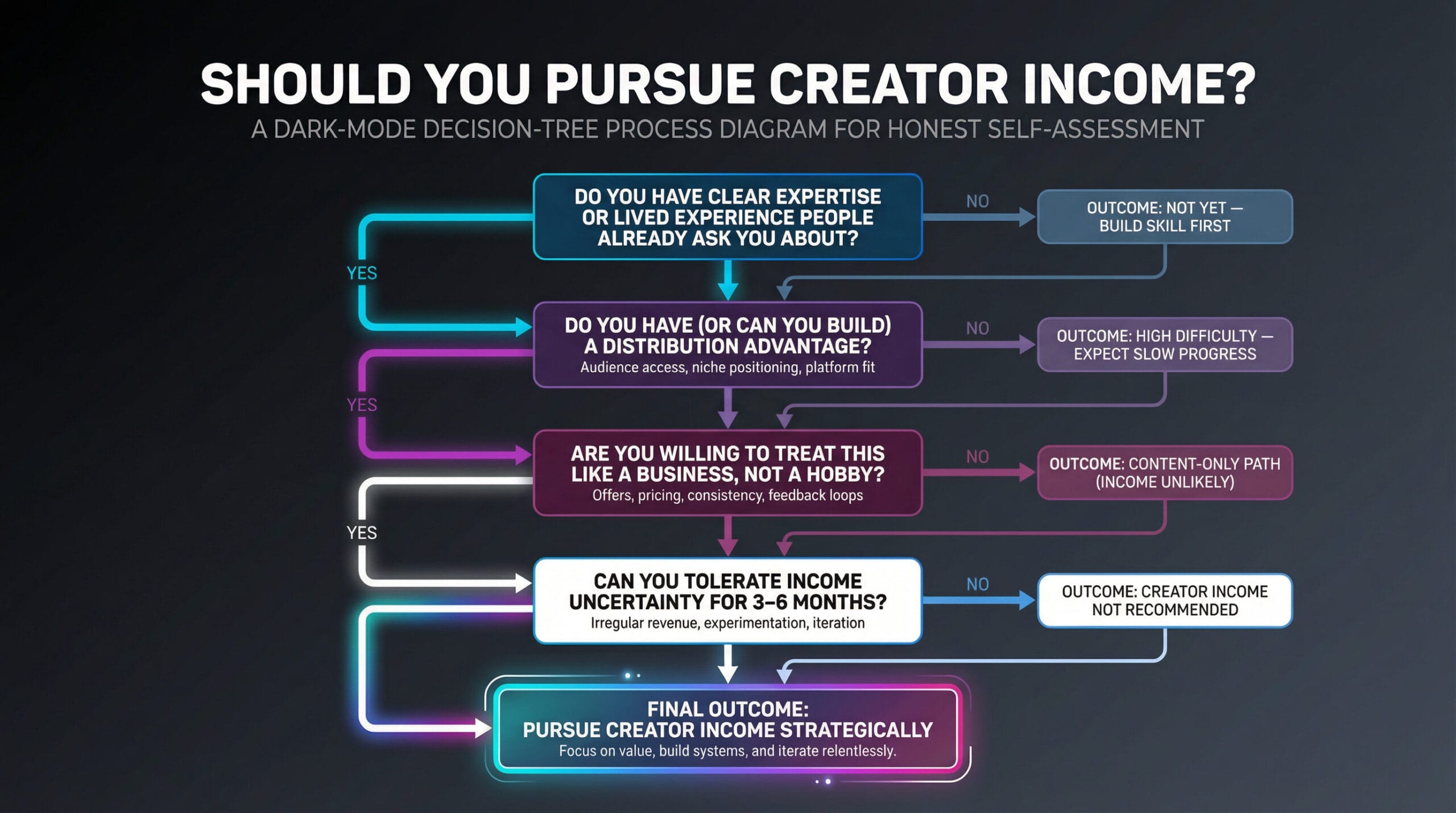
When Creator Income Actually Makes Sense
Creator income is a viable path when you have:
✅ Existing Expertise or Skills People Will Pay to Access
The most successful creators monetize knowledge, not personality.
Examples who succeed:
- Financial advisors who teach investing
- Developers who teach coding
- Designers who teach Figma
- Fitness coaches who teach training
Generic “content creators” struggle because they have nothing specific to sell.
✅ Unfair Distribution Advantages
If you already have an audience from another context, converting that to creator income is much faster.
Unfair advantages include:
- Existing business with customers
- Previous media presence
- Professional network
- Unique access to a community
Building audience from zero takes 12-24 months minimum.
✅ Willingness to Treat It as Actual Business Building
Creator income requires:
- Marketing
- Sales
- Operations
- Analytics
- All other business functions
If you love making content but hate business activities, you’ll enjoy the creation part and fail at the monetization part.
✅ Risk Tolerance for Income Volatility
Creator income fluctuates significantly, especially early on.
If you need stable, predictable income for family obligations or low savings, creator income creates dangerous financial stress.
Timeline to replacement income: 12-24 months for most people who succeed at all.
Ability to Produce Content Consistently for Years
One-off viral content doesn’t build businesses. Consistent output over years does.
If you can’t maintain production discipline or you burn out easily, creator income won’t work.
Bottom line: The creators who succeed treat content as a distribution channel for a real business, not as the business itself. They sell courses, consulting, software, memberships, or other products. Content markets those offers.
When You’re Better Off Doing Something Else
Creator income is a poor choice when:
❌ You Expect Passive Income
Creator income is highly active. Successful creators work 40-60 hours/week on:
- Content production
- Business operations
- Audience management
The “create once, earn forever” model is mostly a myth except for the tiny percentage who build massive platforms.
❌ You Need Stability or Predictable Income
Algorithm changes can cut your income by 50% overnight.
Brand budgets dry up during economic downturns. Platform policies change.
If income predictability matters for your life situation, traditional employment pays better with less stress.
❌ You’re Not Willing to Sell
Monetization requires asking people to buy things.
If you’re uncomfortable with sales, marketing, or promoting your own work, you’ll struggle to convert attention into income.
Many creators produce great content but earn nothing because they won’t actively sell.
❌ You Want Platforms to “Discover” You
The “build it and they will come” approach almost never works.
Building audience requires:
- Active marketing
- Consistent promotion
- Business development
Platforms don’t owe you distribution.
❌ You’re Looking for Quick Results
Average time to first dollar: 6+ months
Average time to replacement income: 12-24 months
Most creators quit before reaching viability.
If you need income in the next 3-6 months, get a traditional job and build creator income on the side.
The Honest Assessment Most People Avoid
Traditional employment pays better with more stability and less risk for the majority of people.
Creator income works for maybe 5-10% of people who try it seriously.
Here’s my recommendation based on your situation:
| Your Situation | What You Should Do |
|---|---|
| Stable employment + limited obligations | Build creator income as side project while keeping job |
| Considering quitting job for full-time creator work | Don’t quit until you have 12+ months savings + 10,000+ engaged followers + already generating some income |
| Need income in next 6 months | Get traditional job, build creator income on side |
| Have expertise people pay for | Creator income viable if willing to build actual business |
| Just like making content | Treat as hobby, don’t expect income |
The creator economy isn’t a lottery where you might get lucky. It’s a specific business model that works under specific conditions.
Evaluate honestly whether those conditions match your situation before investing years of effort. Most people would be better off in traditional employment or freelancing. That’s not pessimism. It’s math.