
You’ve built an audience. Maybe 5,000 followers. Maybe 20,000. Your posts get likes, comments, shares. People tell you they love your content.
But when you try to monetize, nothing happens.
A handful of sales. Maybe a few hundred dollars. Not enough to justify the hours you’re putting in.
This isn’t about working harder or creating better content. The problem is structural. Platforms made it easier than ever to build an audience, but they didn’t make it easier to get paid. 207 million people worldwide now call themselves creators, but only 2% earn more than $100,000 per year.
The gap between attention and income isn’t a bug. It’s how the system was designed.
This guide will show you why audience size and revenue are fundamentally disconnected, and more importantly, which revenue models actually convert small engaged audiences into predictable income. You’ll understand the economic forces working against you, learn which monetization model fits your current audience size, and get a 30-day plan to start generating revenue without growing another 50,000 followers first.
If you’re sitting between 1,000 and 50,000 followers wondering why you’re not making money yet, keep reading.
TL;DR: What Actually Converts Attention Into Income
Audience size does not equal revenue. This isn’t motivational advice. It’s structural economics.
Here’s what actually drives creator income:
✅ Your revenue model must match your current audience size. High-ticket services work at 1,000 followers. Digital products need 5,000-30,000. Choose the wrong model and you’ll waste months no matter how good your content is.
✅ Engagement type matters more than engagement volume. 10,000 likes are worth less than 100 people who reply to your emails or DMs asking for help. Platforms reward consumption behavior. Revenue requires transaction behavior. These aren’t the same thing.
✅ You need a model-first strategy, not a grow-first strategy. The creators making six figures with small audiences chose their monetization model before scaling. The ones stuck at zero revenue tried to grow first and monetize later.
The five models that work at small scale:
- Services
- Communities
- Digital products
- Sponsorships
- Audience-as-asset (newsletters)
Each has a minimum viable audience size. Services can start at 1,000 followers. Courses realistically need 10,000+. Pick wrong and you waste months.
Here’s where most creators mess this up: they choose based on what sounds appealing rather than what their audience composition and size can actually support.
🚩 A 3,000-follower creator trying to launch a course is structurally set up to fail. The same creator offering consulting can be profitable in 30 days.
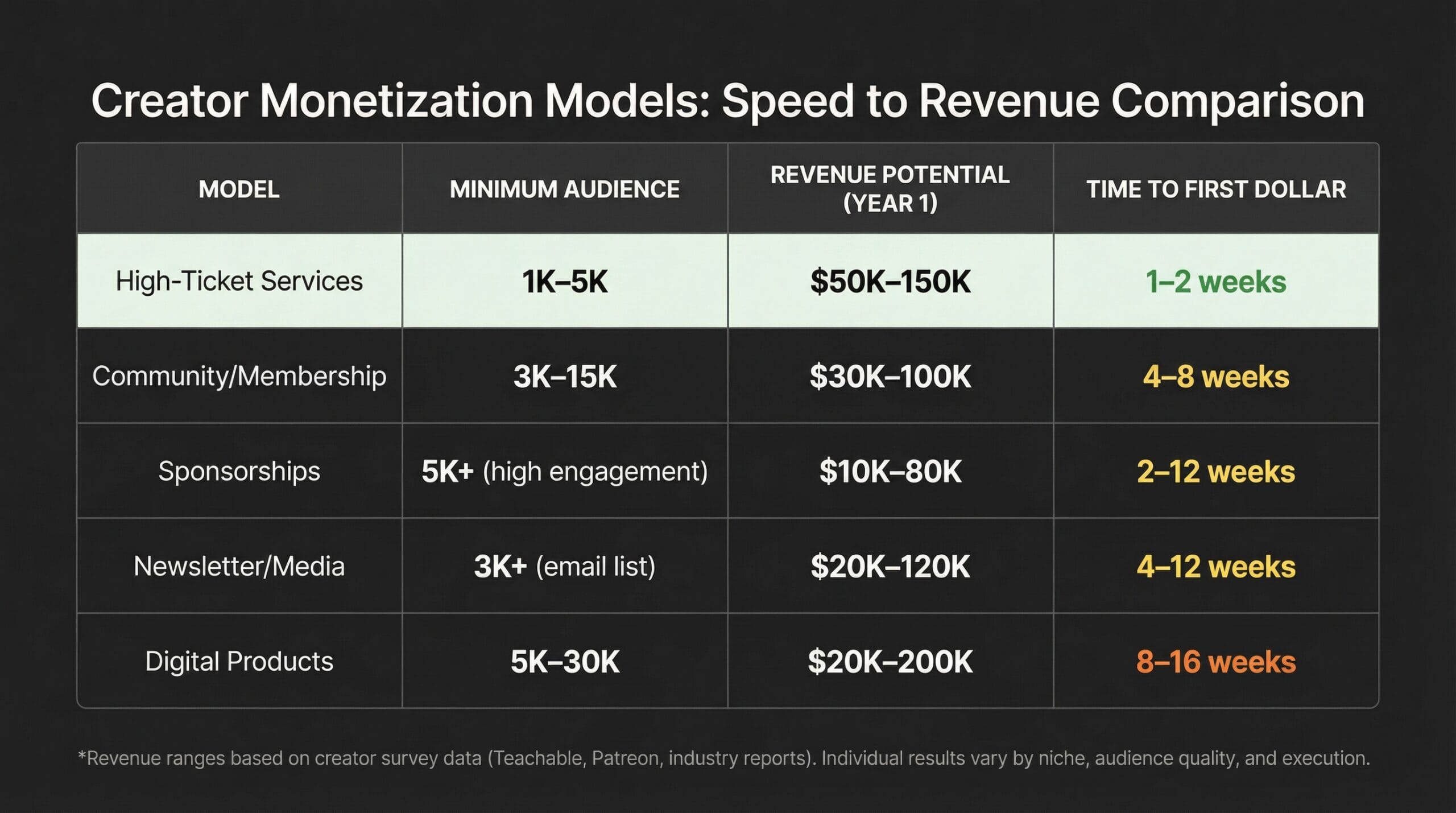
Revenue Model Comparison Table
| Model | Minimum Audience | Revenue Potential (Year 1) | Time to First Dollar |
|---|---|---|---|
| High-Ticket Services | 1K-5K | $50K-150K | 1-2 weeks |
| Community/Membership | 3K-15K | $30K-100K | 4-8 weeks |
| Digital Products | 5K-30K | $20K-200K | 8-16 weeks |
| Sponsorships | 5K+ (high engagement) | $10K-80K | 2-12 weeks |
| Newsletter/Media | 3K+ (email list) | $20K-120K | 4-12 weeks |
Bottom line: If you have 2,000 engaged followers right now, sell services, not courses. If you have 15,000, a membership community is your fastest path to recurring revenue.
Audience size determines model viability. Not the other way around.
Who This Guide Is For (And Who Should Skip It)
✅ This guide is for creators with 1,000 to 50,000 followers who have engagement but inconsistent or no income.
You’re in the right place if:
- You get replies to your content
- People ask you questions in DMs
- You see consistent likes and comments from the same group of people
You’ve proven that people pay attention. You haven’t proven they’ll pay money. That’s the gap we’re closing.
Why this range matters:
This is the monetization sweet spot. You’re past validation (you know people care about your content). You’re not yet at scale where you need a team or complex infrastructure. You can execute any of the five models in this article yourself or with minimal help.
❌ Skip this guide if you’re below 1,000 followers.
Your job is still audience building and niche validation. The monetization playbook is different. Focus on proving people want what you create before worrying about revenue models.
❌ Also skip this if you’re above 100,000 followers.
You’re playing a different game. Your challenges are about teams, managers, brand partnerships at scale, and platform dependency risk. The models here still work, but you need enterprise execution, not startup execution.
The proof this works at small scale:
- One creator made $110,000 last year with only 76 paying customers
- Another makes $3,000 monthly from a 4,500-person email list
If you’re in this range and not making money, it’s not because your audience is too small. It’s because you haven’t matched the right model to your current size.
Why Growing Your Audience Doesn’t Automatically Generate Revenue
The creator economy created a trap. Platforms made it radically easier to build an audience, but they kept monetization centralized and difficult.
The result: Millions of creators with audiences and almost no income.
This isn’t about platforms being evil. It’s about business model math.
How platform economics work:
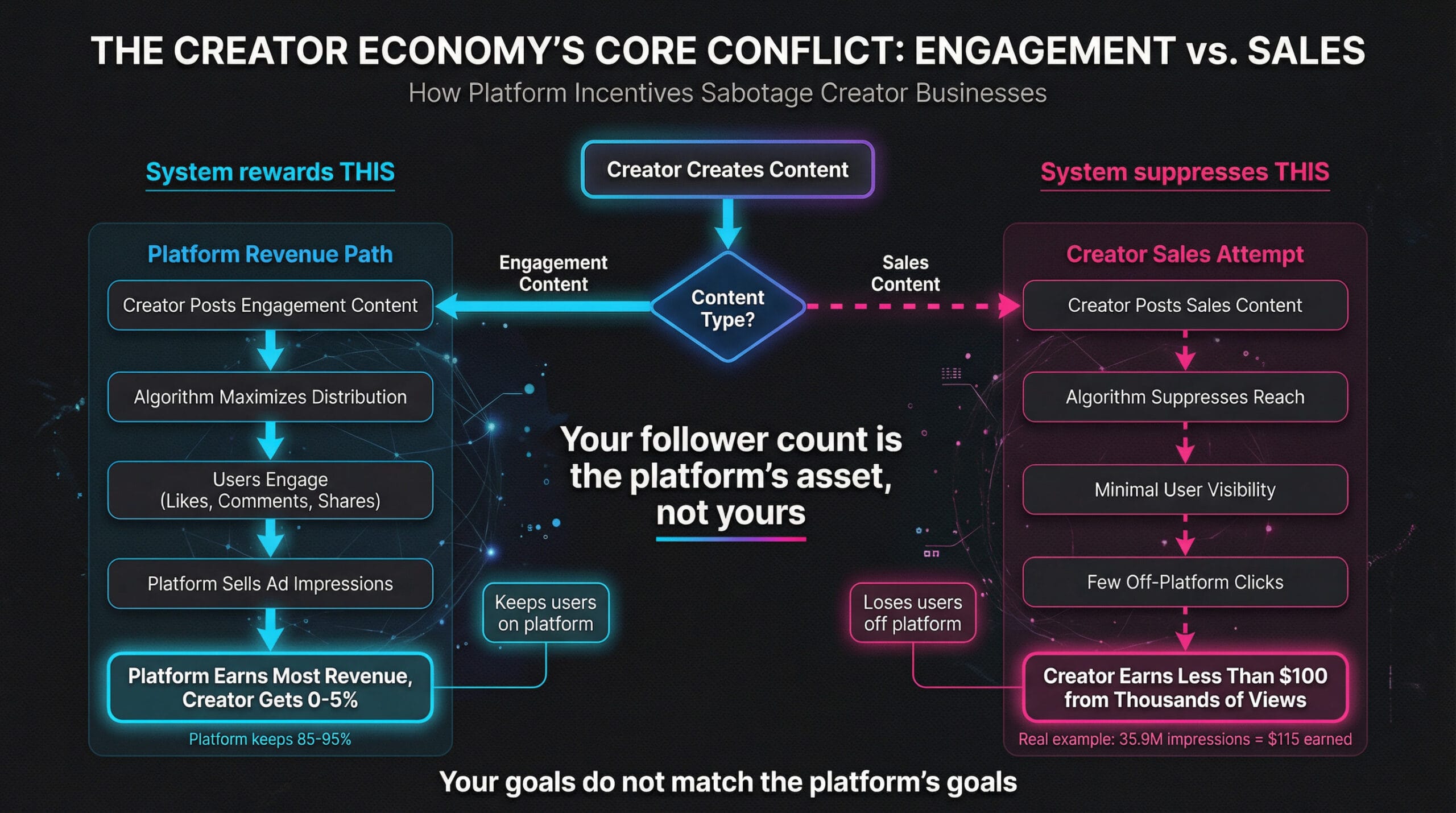
Platforms like Instagram, TikTok, and YouTube make money from advertising. Their revenue comes from keeping users on the platform as long as possible.
More watch time = More ad impressions = More revenue for the platform
They optimize their algorithms for one thing: engagement that keeps people scrolling.
The misalignment:
Your monetization goals and their revenue goals are fundamentally opposed.
- When you post content that gets likes and shares, you’re generating ad revenue for the platform
- When you try to send people off-platform to buy something, you’re working against the algorithm
The system rewards content that keeps people in the feed, not content that converts them into customers.
🚩 Real example: One creator earned $115 from 35.9 million impressions on X. The platform extracted value from those impressions through ad revenue. The creator got scraps because creator payouts were never the primary business model.
The Platform Incentive Problem
Platforms optimize for watch time, not your wallet.
- Instagram wants people watching Reels for hours
- TikTok wants endless scrolling
- YouTube wants binge-watching
None of them financially benefit when your audience leaves to buy your product.
Here’s the structural problem:
The content that performs best on platforms (entertaining, engaging, shareable) is often not the content that drives purchase behavior.
You can have 50,000 followers who love your content and never buy anything because the platform trained them to consume, not purchase.
Think of it this way: Your follower count measures platform value, not your value. Every view you generate makes money for the platform whether you ever earn a dollar or not.
Engagement vs. Purchasing Intent
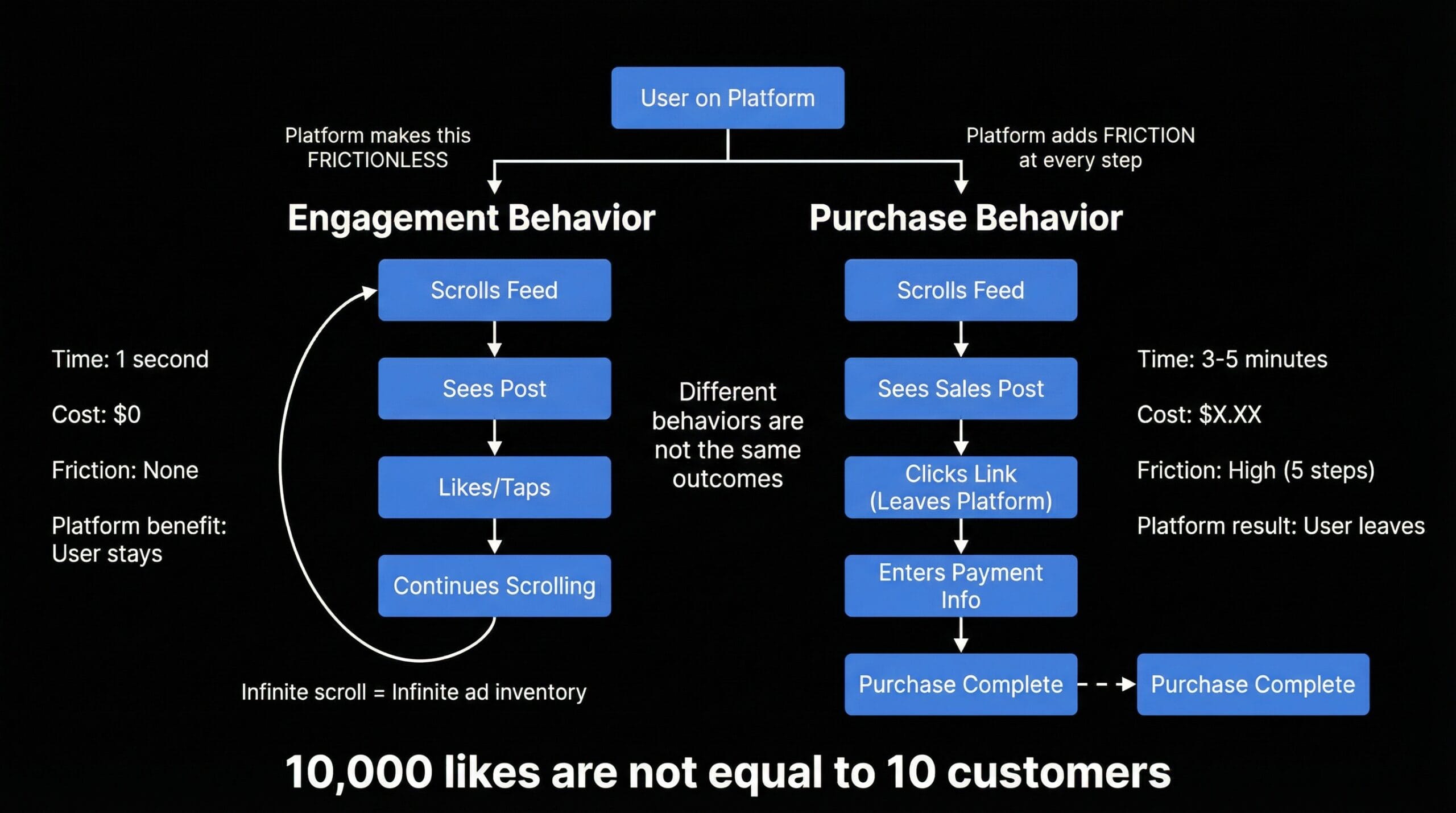
10,000 likes do not equal 10 customers.
These are different behaviors driven by different motivations.
Engagement behavior is passive:
Someone scrolls, sees your post, double-taps, keeps scrolling.
- Takes 1 second
- Costs nothing
- Signals mild interest or entertainment value
- Platforms make this frictionless because it generates ad inventory
Purchase behavior is active:
Someone has to:
- Stop scrolling
- Click a link
- Leave the platform
- Pull out a credit card
- Complete a transaction
It requires intent, trust, and perceived value that exceeds price. Platforms make this harder because it removes the user from their ecosystem.
The conversion gap:
- Small engaged audiences: 5-10% conversion rates
- Large disconnected audiences: 1-2% conversion rates
Real math: A creator with 5,000 followers where 500 people consistently engage can often out-earn a creator with 100,000 followers where only 2,000 engage.
The math favors depth over breadth. Always has.
The bottom line:
Attention became abundant. Anyone can build an audience now. There are 207 million people calling themselves creators.
Platforms democratized attention. They didn’t democratize monetization.
They kept that controlled through:
- Revenue sharing (15-50% platform cuts)
- Algorithmic suppression of sales content
- Platform fees on all transactions
Most creators have audiences and no income. They’re generating value for platforms while trying to figure out how to capture value for themselves.
This isn’t a personal failure. It’s the system working exactly as designed.
The 5 Revenue Models That Convert Small Audiences Into Income
These five models work because they align with small audience economics. You don’t need scale. You need depth, trust, and transaction intent.
Each model has:
- A minimum viable audience size
- An ideal customer profile
- Specific execution requirements
Choose based on what you have now, not what you wish you had.
Model 1: High-Ticket Services
Services are the fastest path from audience to income. You can launch this week.
What this means:
High-ticket services = Coaching, consulting, strategy sessions, or done-for-you work priced at $1,000-10,000 per client.
The math: At 1,000-5,000 followers, you only need 5-10 clients per year to make $50,000-100,000.
Why this works:
Services require trust, not scale.
If 1,000 people follow you, maybe 50-100 are in your target market. If 10 of those have the problem you solve and the budget to pay for it, you’re profitable.
You don’t need everyone to buy. You need the right 10 people.
The execution is simple:
Offer:
- A specific outcome
- To a specific audience
- At a specific price
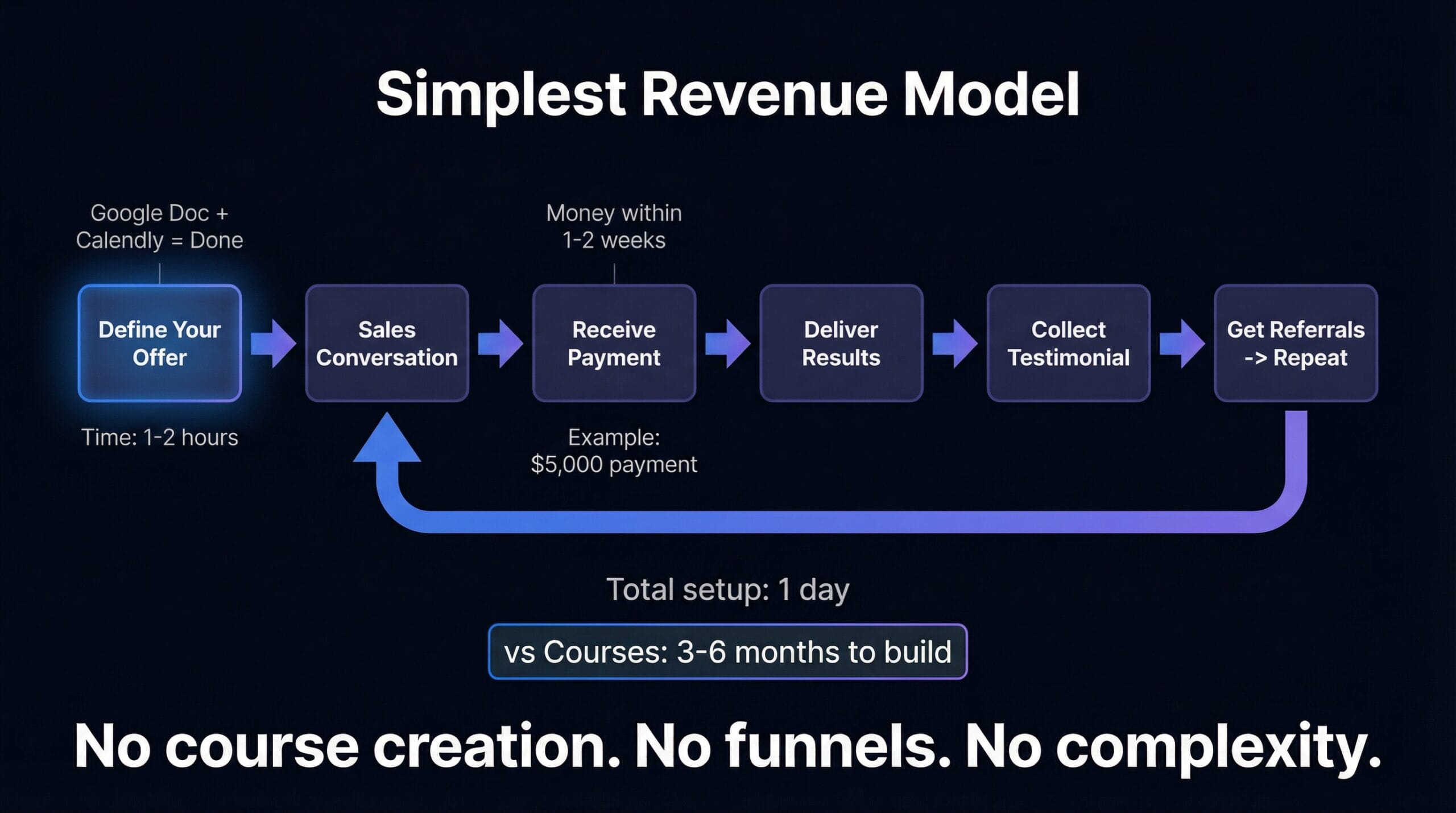
No course creation. No product infrastructure. No complicated funnels. You sell time and expertise directly.
Real example:
One creator went from 2,000 followers to $80,000 in annual revenue offering brand strategy consulting.
- 5 clients
- $16,000 each
- The entire business model fit in a Google Doc and a Calendly link
Who this works for:
✅ Creators with demonstrable expertise ✅ Confidence selling high-ticket ✅ Ability to deliver results
If you’ve worked in an industry for 5+ years, you know more than 95% of people trying to break in. That knowledge is worth money.
🚩 Here’s where most people mess this up:
Under-pricing because their audience doesn’t feel big enough to justify high prices.
But you’re not charging for audience size. You’re charging for outcome value.
If you help a business make $100,000, charging $10,000 is cheap. Your follower count is irrelevant to that math.
Model 2: Community/Membership
Communities work at 3,000-15,000 followers when you have enough people to create peer-to-peer value.
What this means:
A membership community charges $20-100 per month for:
- Access to exclusive content
- Discussion space
- Direct interaction with you and other members
The value comes from ongoing access and peer learning, not one-time information delivery.
Why you need critical mass:
Below 3,000 followers, you won’t have enough paying members to create the network effects that make communities valuable.
People pay for community because other valuable people are there.
If it’s just you and 8 members, there’s no peer value. I’d avoid launching a community until you can realistically get 50+ members on day one.
The recurring revenue engine:
Real example: One creator runs a 120-person community at $50/month.
- $6,000 monthly
- $72,000 annually
- Total audience: about 8,000 followers
She reports this generates more stable income than brand deals ever did with 10x the audience.
Why the math works:
Members stay for months or years, not just one transaction.
Lifetime value calculation:
- A single member paying $50/month for 18 months = $900 in lifetime value
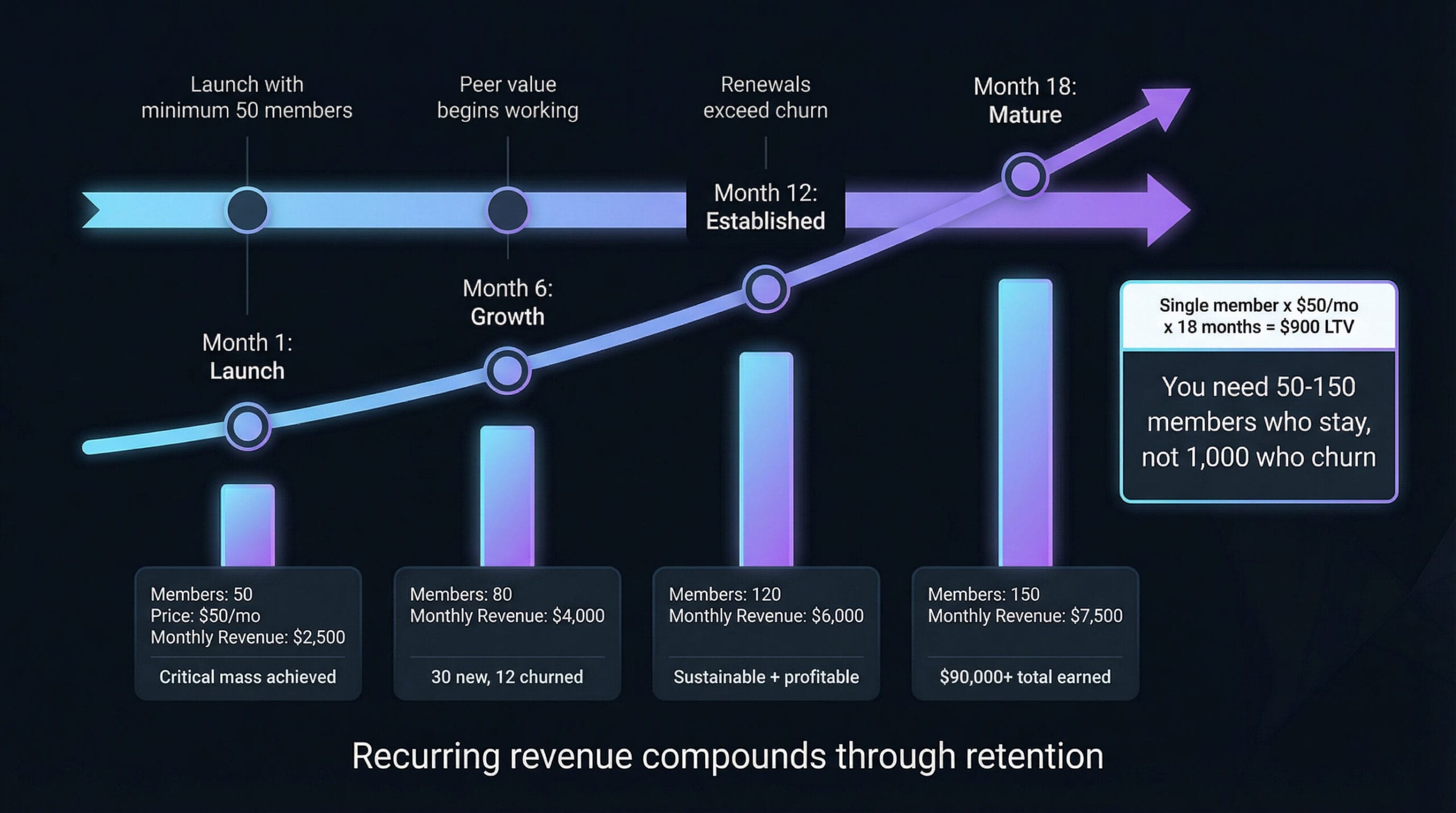
You don’t need thousands of members. You need 50-200 people who stick around.
What execution requires:
- Platform choice (Circle, Discord, Slack)
- Content calendar
- Community management
- Member retention strategy
🚩 This isn’t passive. You’re running an ongoing service. But it’s also not trading time for money at a 1:1 ratio like pure services.
The failure mode:
Launching too early.
If you only have 1,500 followers, you might get 15-30 members. That’s not enough to create the community dynamic that retains people. They’ll churn within 2-3 months because it feels empty.
Wait until you can realistically launch with 50+ members on day one.
Model 3: Digital Products
Digital products (courses, templates, frameworks, toolkits) work at 5,000-30,000 followers because you need launch volume.
Real example:
One creator made $110,000 last year selling online courses to 76 students.
- Average price: $1,437 per course
- This works because digital products can command premium prices if they deliver transformation, not just information
Why this model has leverage:
You create once, sell many times.
After the upfront creation work:
- Each sale is nearly pure profit
- No delivery time
- No client management
- The product sells while you sleep
🚩 But here’s what most creators underestimate:
The infrastructure required.
You need:
- Email sequences
- Sales pages
- Payment processing
- Course hosting
- Student onboarding
- Launch strategy (usually involving affiliates or webinars)
It’s not “upload and profit.” It’s a product launch every time.
Why minimum viable audience is higher:
Conversion rates on cold launches run 1-3%.
Example scenarios:
| Followers | Conversion Rate | Customers | Price | Revenue |
|---|---|---|---|---|
| 5,000 | 2% | 100 | $200 | $20,000 |
| 2,000 | 2% | 40 | $200 | $8,000 |
At 2,000 followers, a 2% conversion = 40 customers.
If you’re selling a $200 course, that’s $8,000. After platform fees and ad spend, you might net $5,000-6,000.
But it took you 3 months to build the course. The ROI is weak compared to services.
The right progression:
The best digital product creators are former service providers who systemized what they were already doing.
Real example:
One creator:
- Sold brand strategy consulting for $5,000 per client
- After working with 30 clients, noticed he was solving the same problems with the same frameworks
- Packaged that into a $500 course
- Now makes $200,000 annually selling the course to people who can’t afford the consulting
When to use this model:
✅ You’ve done the work ✅ You know it works ✅ You want leverage
❌ Skip this if: You’re trying to create passive income from scratch without proven expertise
Model 4: Sponsorships/Partnerships
Brand sponsorships work at 5,000+ followers if engagement is high. Nano-creators with under 10,000 followers regularly make $3,000-15,000 per year from brand deals.
Why the economics shifted:
Brands used to pay for reach. Now they pay for influence and trust.
A creator with 10,000 highly engaged followers in a specific niche is more valuable than someone with 500,000 random followers who barely interact.
Real example:
One nano-creator made $3,000 in a year with about 8,000 followers across platforms.
- The deals were small: $200-500 per post
- But consistent
- Brands wanted access to her specific audience in the outdoor/fitness space
- She had high engagement rates and audience trust
That’s what they paid for.
🚩 The mistake:
Waiting until you have a massive audience.
Micro and nano creators actually have advantages:
✅ Your audience trusts you more because you’re not a celebrity ✅ Your engagement rates are higher because you respond to comments and DMs ✅ You’re more affordable than macro influencers, so brands can test with you
The execution path is outreach:
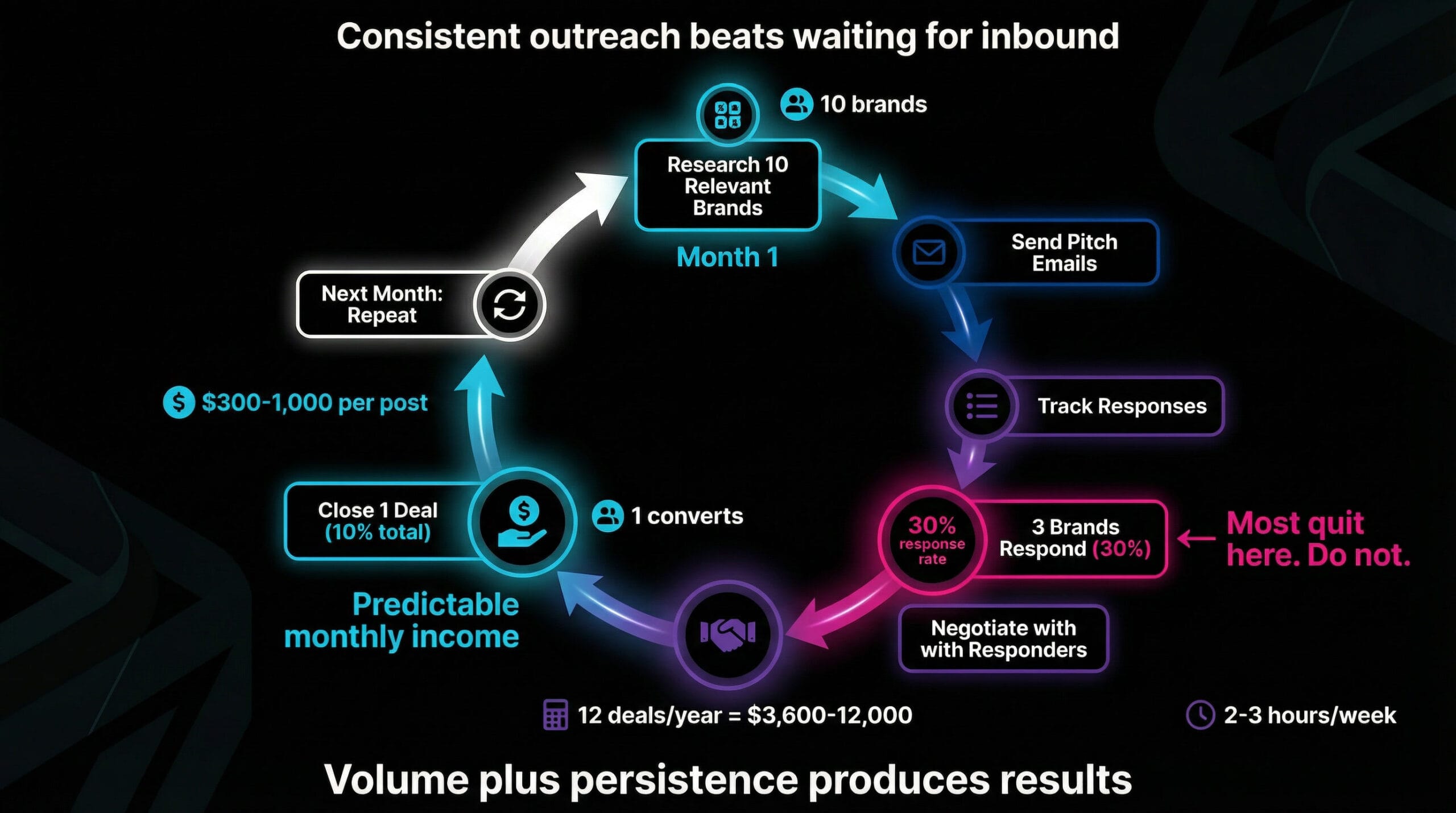
Most small creators wait for brands to come to them. That rarely happens.
You have to pitch:
- Find brands your audience already uses
- Show them your engagement metrics
- Explain why your audience matches their customer profile
- Propose a collaboration
Real pitch cadence:
One creator pitches 10 brands per month.
- 3 respond
- 1 converts
- That’s 1 deal per month at $300-1,000 depending on scope
Over a year: $5,000-12,000 from sponsorships alone.
Combined with other models, it’s meaningful revenue.
The quality filter:
Only work with brands you actually use or would recommend.
Your audience will know if you’re shilling for a paycheck. One bad partnership can destroy months of trust building.
Model 5: Audience-as-Asset
Newsletters and subscription content platforms represent the “own your distribution” model.
Why this works:
You’re building an asset the platform can’t take away.
- Email lists
- Substack subscribers
- Patreon members
These are yours. If Instagram changes the algorithm tomorrow, your newsletter still reaches 100% of subscribers.
The model is simple:
Offer valuable content directly to people’s inbox or a paid platform.
Charge: $5-20 per month
The math: At 1,000 paying subscribers and $10/month = $120,000 per year
The platform takes 10% instead of 50%, so you keep significantly more than algorithmic ad revenue models.
The industry shift:
Direct-to-fan revenue now represents over 50% of the $290 billion creator economy.
Creators are moving away from algorithm-dependent platforms toward owned channels where they control access and pricing.
The challenge:
Conversion from social to owned channel.
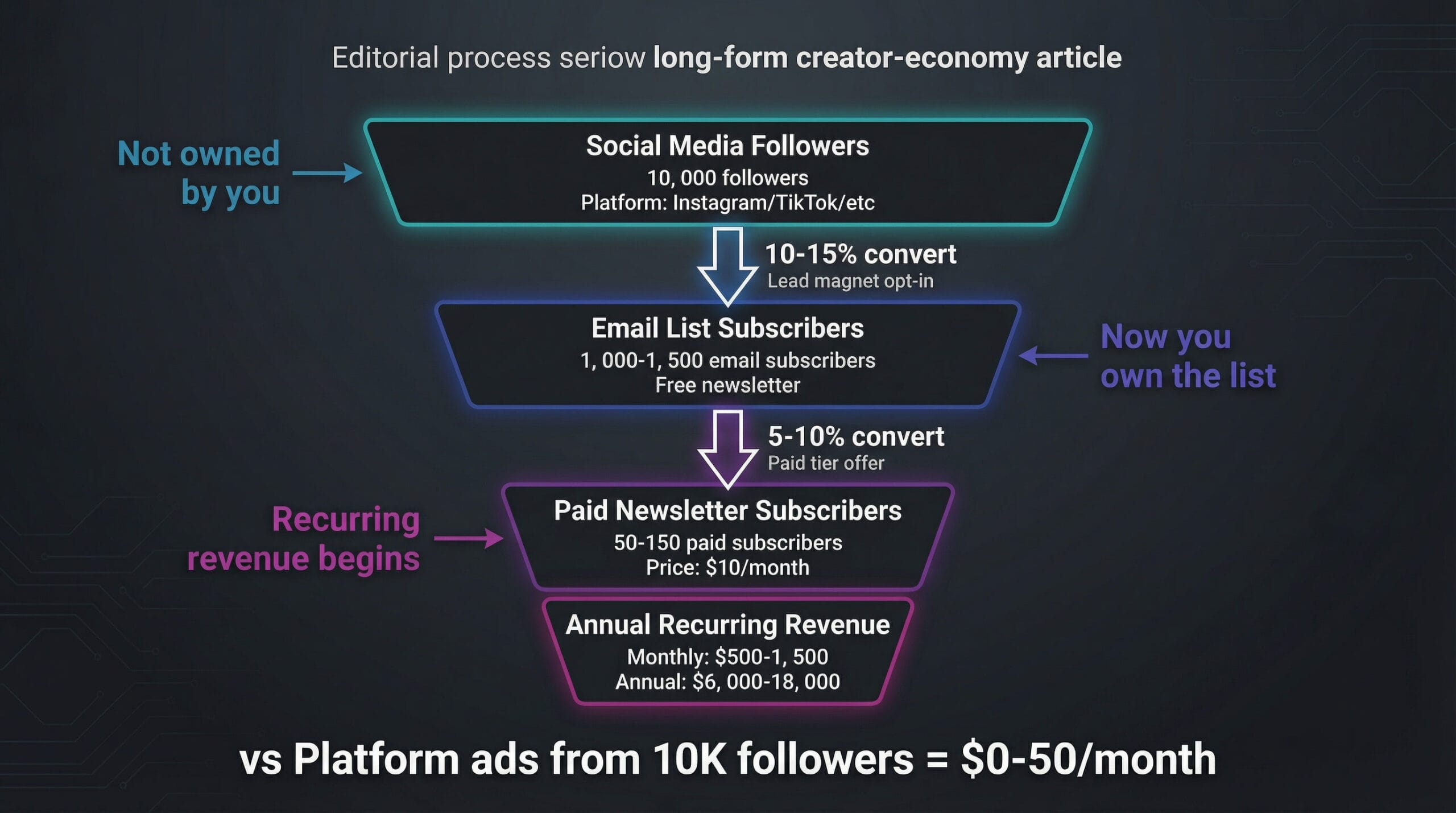
If you have 10,000 Instagram followers:
- Maybe 500-1,500 will subscribe to your email list
- Of those, maybe 5-10% will pay for a premium subscription
- That’s 25-150 paying subscribers
- At $10/month = $3,000-18,000 annually
Why this model compounds:
Unlike sponsorships where you get paid once per post, subscribers pay every month.
Lifetime value: A subscriber who stays for 2 years = $240 in lifetime value
Focus on retention, not just acquisition.
The execution requirement:
Content consistency.
You can’t launch a paid newsletter and post twice a month. Subscribers expect weekly or bi-weekly value.
You’re trading reach for revenue and responsibility.
Real example:
One creator with 4,500 email subscribers makes $3,000 monthly from a paid newsletter.
Before: She had ad-based blogging where 35,000 monthly visitors earned her $2.85.
After: Same effort. 100x the revenue.
The difference: Owning the relationship and charging directly.
Common Mistakes That Kill Monetization (Even With a Loyal Audience)
Most creators fail monetization not from lack of audience, but from execution errors that are completely avoidable.
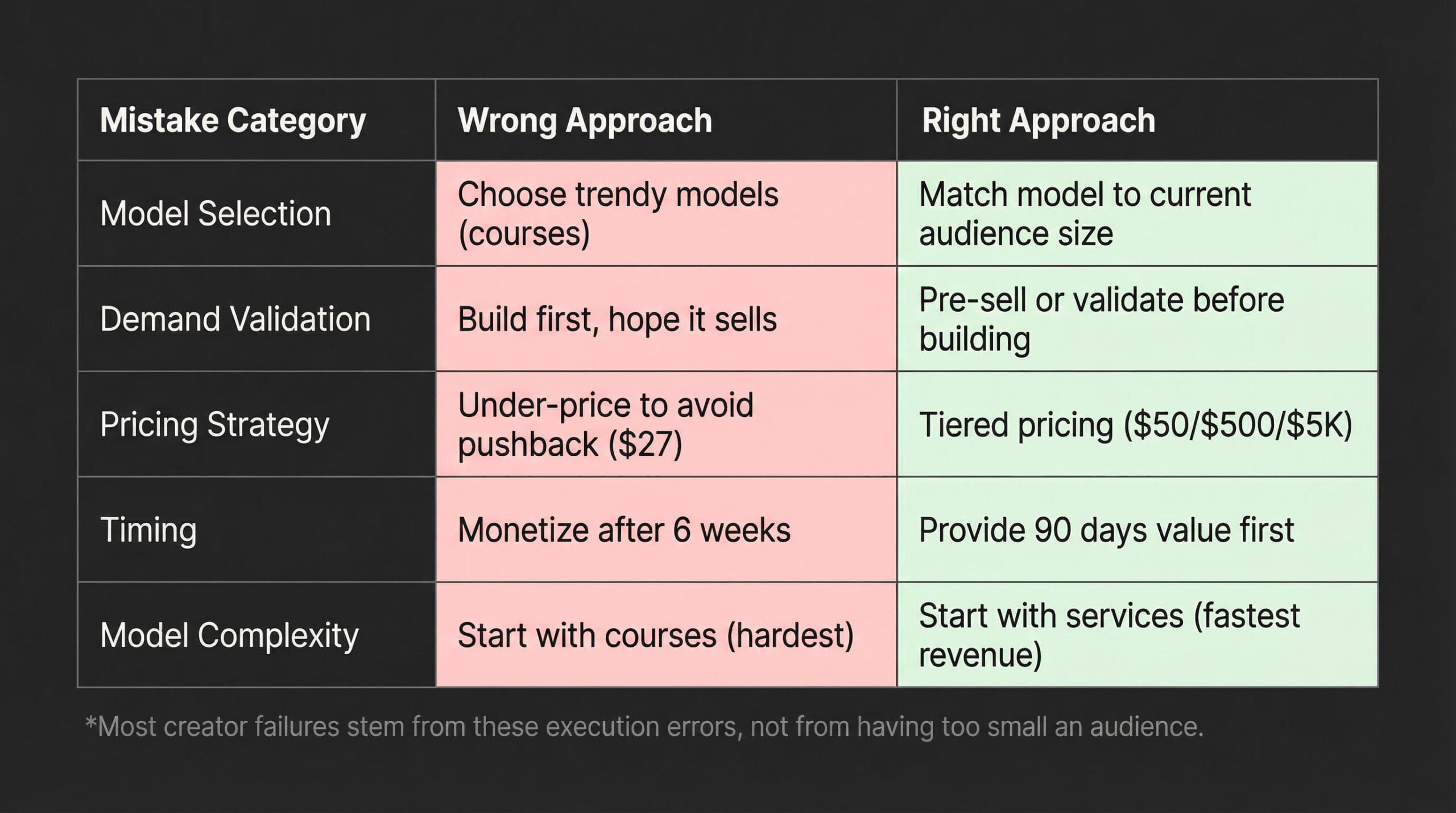
❌ Mistake 1: Choosing a model based on trends instead of fit
The problem:
Courses are popular because everyone talks about passive income. But if you have 2,000 followers and no email list, launching a course will fail.
What works: Services or sponsorships first.
The model has to match your current assets, not your aspirations.
❌ Mistake 2: Building before validating demand
Bad example:
One well-known creator with a large following launched a book and sold 100 copies in the first year.
Good example:
Another creator with a smaller audience pre-sold a $500 framework for $14,000 before building anything.
The difference:
- Build-and-hope = Failure
- Validate-and-build = Success
The first creator assumed his audience would buy. The second creator asked, got commitments, then built.
❌ Mistake 3: Under-pricing from guilt
The problem:
You feel weird charging your audience money because they got used to free content.
So you price:
- Your course at $27 when it should be $297
- Your consulting at $500 when it’s worth $5,000
Why this hurts you:
This doesn’t just reduce revenue. It signals low value.
People associate price with quality. Under-pricing makes people skeptical.
✅ The fix: Tiered pricing
Offer:
- $50 ebook
- $500 workshop
- $5,000 consulting
This captures casual supporters and true fans.
- The person who can only afford $50 gets value
- The person who needs deep help can pay for it
- You’re not leaving money on the table
- You’re serving different audience segments
❌ Mistake 4: Monetizing before establishing trust
The problem:
If you’ve been posting for 6 weeks and suddenly launch a $1,000 offer, your audience will reject it.
They don’t know you well enough yet. They haven’t seen enough proof you deliver value.
Asking for money too early breaks the trust-building process.
✅ The 90-day rule:
90 days of consistent value before monetization.
Three months of:
- Helping people
- Answering questions
- Sharing frameworks
- Proving expertise
Then you’ve earned the right to ask. Before that, you’re the person who showed up to extract value, not provide it.
❌ Mistake 5: Picking the hardest model first
The problem:
New creators see successful course creators and think “I should make a course.”
But courses are the hardest model to execute.
You need:
- Content creation skills
- Launch strategy
- Email marketing
- Sales copywriting
- Ongoing student support
It’s a business, not a product.
✅ Services are easier:
You need:
- A calendar link
- A sales conversation
Someone pays, you deliver the work, they get results.
You can start this week.
Once you have cash flow and testimonials, you can build the course. Starting with courses is starting on hard mode for no reason.
The recommended progression:
1. Services first for fast cash flow 2. Community second for recurring revenue 3. Products third for leverage
Each builds on the previous:
- Services give you customer insight and testimonials
- Community gives you a testing ground for frameworks
- Products package everything you’ve already proven works
How to Choose Your Revenue Model (Decision Framework)
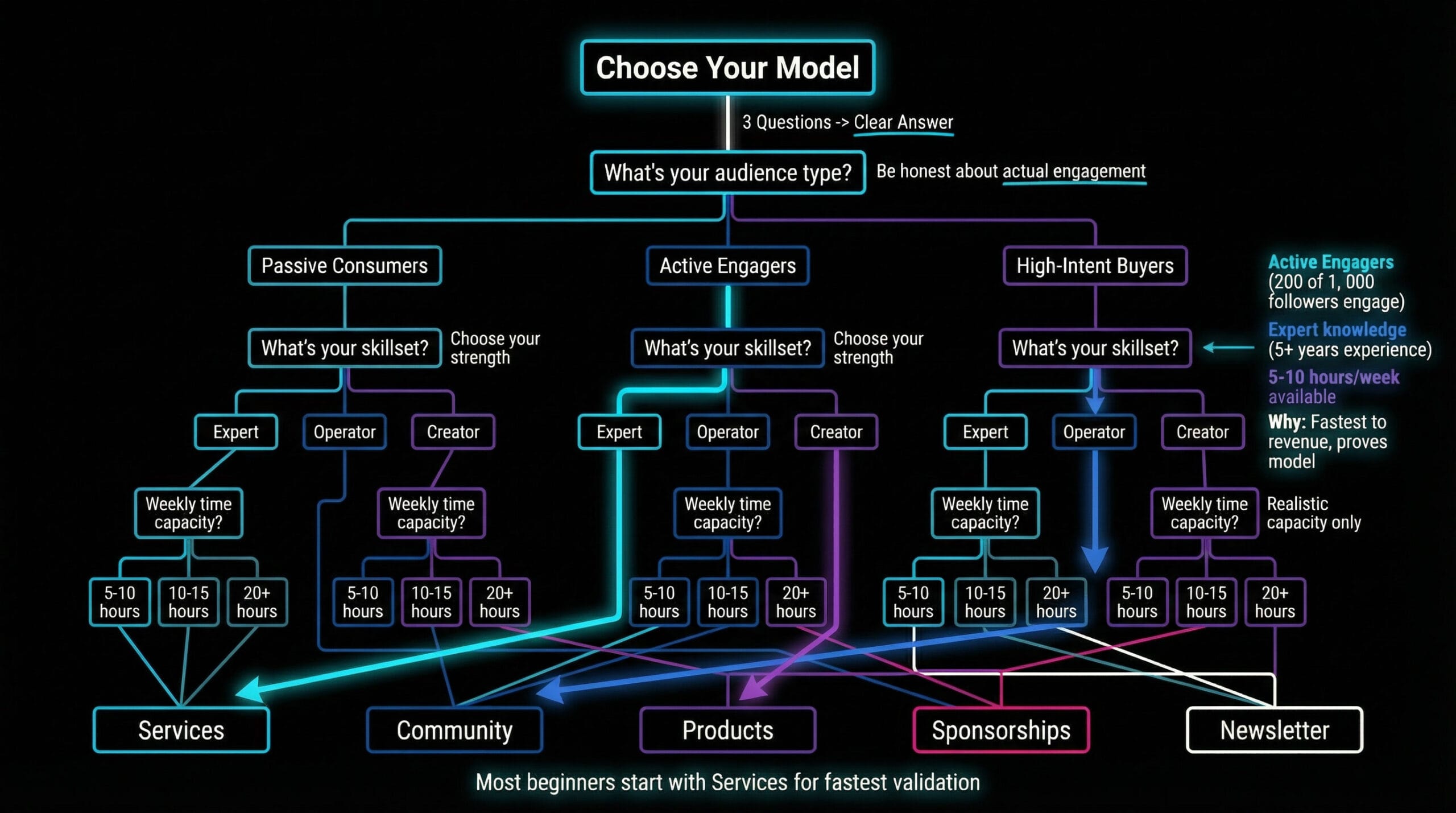
Most creators overcomplicate model selection. You need three data points:
- Audience composition
- Your skillset
- Execution capacity
Understanding Audience Composition
Who’s actually following you?
Ask yourself:
- Are they passive consumers or active engagers?
- Are they individuals or businesses?
- Are they in a buying mode or browsing mode?
If 90% of your followers never comment, never DM, never reply:
You have lurkers.
Lurkers won’t:
- ❌ Buy high-ticket services
- ❌ Join communities
- ✅ Might buy a cheap digital product if the marketing is good
Your model options are limited.
If you have 1,000 followers and 200 people consistently engage:
You have buyers.
Those 200 people have transaction intent. They’re not just entertained. They want help.
You can sell services, communities, or products to this group.
If your audience is mostly businesses or professionals:
High-ticket services work.
B2B audiences have budget and buy based on ROI.
If your audience is mostly consumers or hobbyists:
Lower-priced products and communities work better.
Matching Skillset to Model
Who are you as a creator?
- Expert with specialized knowledge?
- Operator who runs systems?
- Creator who makes things?
- Entertainer who builds personality-driven content?
Model matching:
| Your Type | Best Models |
|---|---|
| Expert | Services + Products |
| Operator | Communities + Memberships |
| Creator | Products + Sponsorships |
| Entertainer | Sponsorships + Audience-as-Asset |
Why this matters:
Trying to force the wrong model to your skillset creates misery.
- If you hate sales calls, don’t choose services
- If you can’t manage ongoing programs, don’t choose communities
- Pick what you can actually execute without burning out
The 3-Question Model Fit Test
Run this test before committing to a model.
Question 1: What’s my audience type?
- Passive consumers?
- Active engagers?
- High-intent buyers?
This determines: Price point and model complexity you can support
Question 2: What’s my skillset?
- Expert knowledge?
- Operational systems?
- Creative production?
- Personality/entertainment?
This determines: What you can credibly deliver
Question 3: Can I execute this?
Do I have:
- The time?
- The tools?
- The mental energy to launch and maintain this model?
This determines: Realistic options vs aspirational ones
Model fit matrix:
| Audience Type | Skillset | Weekly Capacity | Recommended Model |
|---|---|---|---|
| Active engagers | Expert knowledge | 5-10 hours | Services |
| High-intent buyers | Operational skills | 10-15 hours | Community |
| Passive consumers | Creative production | 20+ hours | Products |
When all three align, monetization is straightforward. When they don’t, you’re fighting uphill.
Stacking Models Over Time
The best creators don’t pick one model forever. They stack models as they grow.
The typical progression:
Services → Community → Products
Why this works:
1. Services first:
- Fast cash flow
- High learning
- You talk to customers
- Understand their problems deeply
- Develop frameworks that work
- This is paid market research
2. Community second:
Once you have 10-20 service clients, you’ve identified patterns.
The same problems come up repeatedly. You’ve solved them multiple times.
This is your signal to build a community or productize the solution.
Launch a community for people who:
- Can’t afford full service
- Want ongoing access to your frameworks
- Benefit from peer learning
This adds recurring revenue and reduces 1:1 time commitment.
3. Products third:
After running the community for 6-12 months, you’ve refined your frameworks further.
You know exactly what works.
Now you build the course or template. This is leverage.
You keep:
- The services (for premium clients)
- The community (for ongoing support)
- The product (for scale)
Real example:
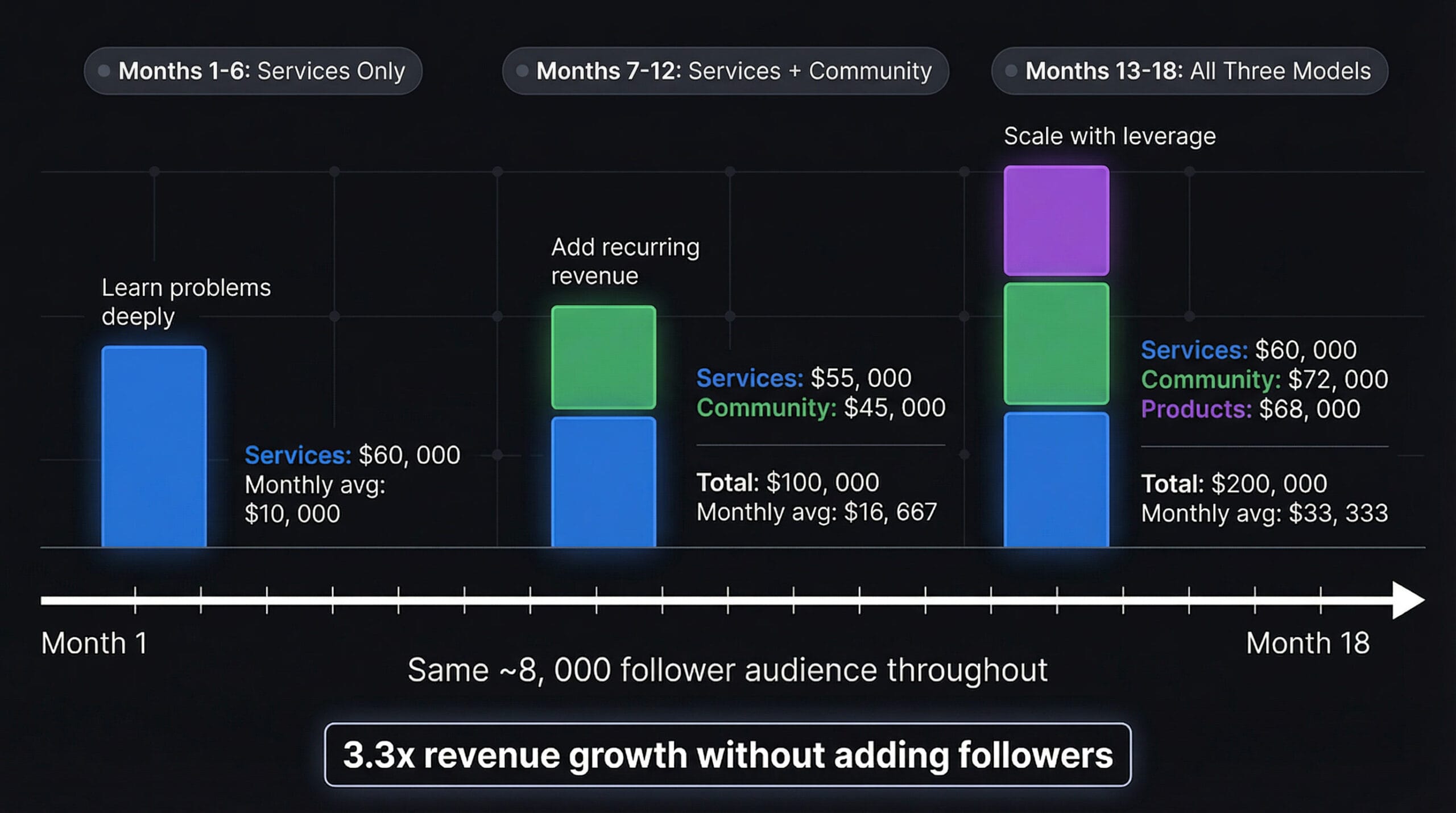
One creator went from $0 to $200,000 in 18 months using this stack.
| Timeline | Models | Revenue |
|---|---|---|
| Month 1-6 | Services only | $60,000 |
| Month 7-12 | Services + Community | $100,000 |
| Month 13-18 | Services + Community + Course | $200,000 |
Same audience size. Three revenue streams.
Why stacking works:
Different people buy at different price points.
Your $5,000 service client and your $500 course buyer are different people. Both are in your audience. Both have money to spend.
By offering both, you capture more total value.
🚩 The mistake: Trying to stack too early
If you launch services, a community, and a course in the same month, you’ll execute all three poorly.
Start with one, prove it works, add the next.
Sequential stacking beats simultaneous launch.
Your First 30 Days: Getting to Revenue With Your Current Audience
Most creators waste months building when they should spend weeks validating. This 30-day plan prioritizes speed and learning over perfection.
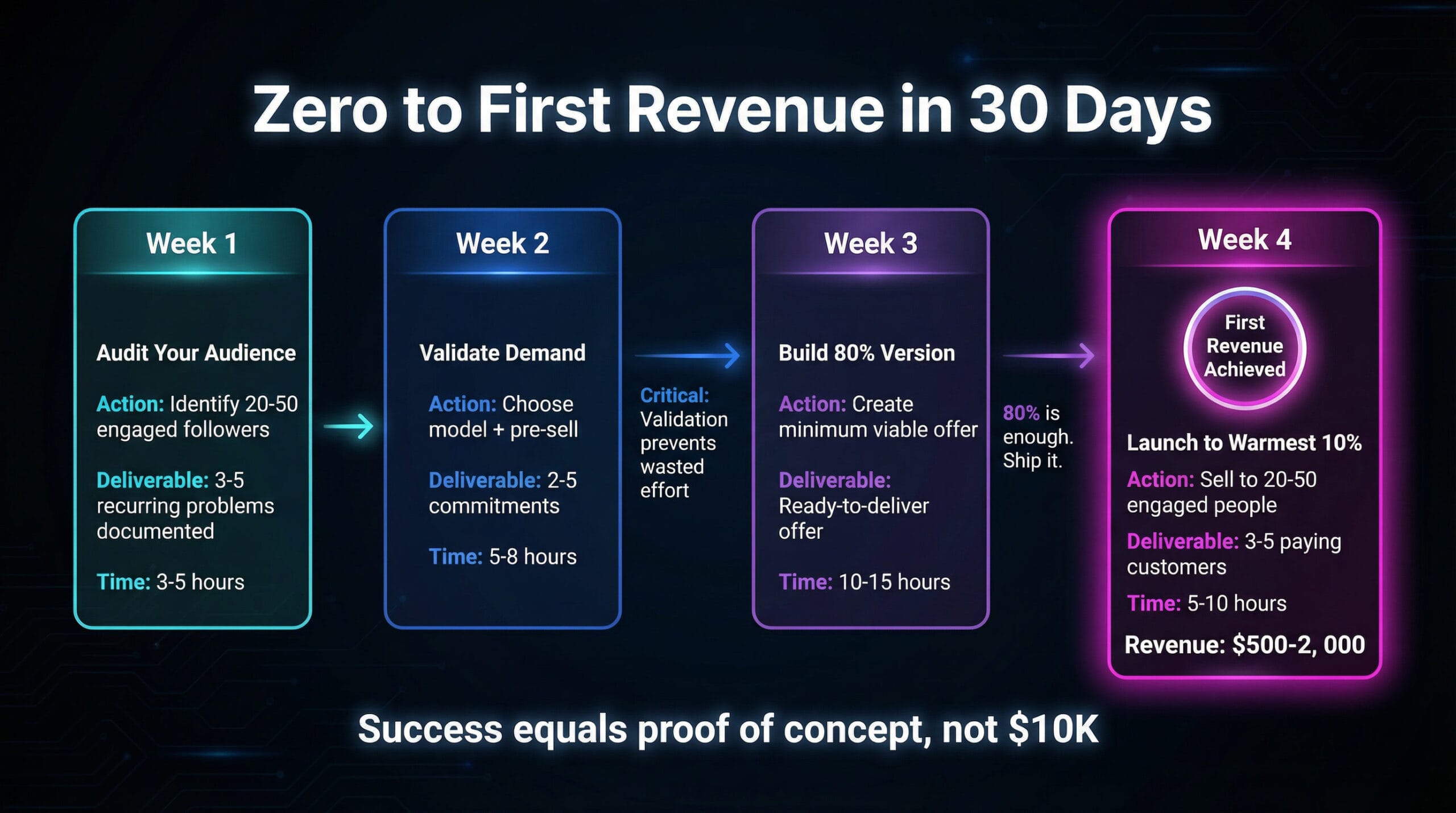
Week 1: Audit Your Audience
You need to know who’s actually engaged and what they care about.
Action steps:
- Go through your last 30 days of content
- Identify the 20-50 people who consistently comment, like, DM, or engage
- These are your potential buyers. Everyone else is audience, not customers
Deep dive:
Read through every DM and comment from these people.
Ask yourself:
- What questions do they ask?
- What problems do they mention?
- What language do they use to describe their struggles?
This is your product research. You’re looking for patterns.
Pattern recognition:
✅ If 10 people ask variations of “how do I get my first client” → Validated problem ✅ If 8 people say “I don’t know how to price my services” → Validated problem  If only 1 person asks about something → Not a pattern yet
Document exact phrases:
- “I feel stuck”
- “I don’t know what to do next”
- “I tried X and it didn’t work”
The specific language tells you:
- What outcome they want
- What obstacle they perceive
End of Week 1 deliverable:
A list of 3-5 recurring problems your engaged audience mentions, written in their exact words.
Week 2: Pick One Model and Validate Demand
Don’t build anything yet.
Action steps:
- Take the most common problem from your audit
- Choose the model that fits your current audience size (use the table from earlier)
- Test if people will actually pay
If you have 2,000 followers: Services If you have 8,000 followers: Community or products
Validation Method 1: Simple post
“I’m thinking about offering X to help you solve Y. If I made this available, would you be interested?”
See who responds. This is your signal.
Validation Method 2: Pre-sell (better)
“I’m offering 5 strategy sessions at $1,000 to help you solve X. First 5 people to DM me get access. Payment required to hold your spot.”
If nobody pays, you don’t have validated demand. If 2-3 people pay, you have proof.
Real example:
One creator posted: “Working on a template for X. $50, launches Friday. Comment if you want early access.”
- Got 47 comments
- Sold 47 copies on launch
- $2,350 in revenue before building the final product
That’s validation.
If your validation fails:
Your offer or positioning is wrong.
Go back to the audit. Try:
- A different problem
- A different model
- Do not build without validation signal
Week 3: Create Your Minimum Viable Offer
No perfectionism allowed.
Your first version should be embarrassingly simple.
If it’s a service:
You need:
- A Google Doc with the offer, outcome, price
- A booking link (Calendly, etc.)
That’s it.
Real example:
One creator launched consulting with:
- A Google Doc outline of what he’d deliver
- A Calendly link
Made $15,000 in the first month. He added the fancy stuff later after he had revenue and testimonials.
If it’s a template or guide:
Build the 80% version.
It should be:
- Usable
- Valuable
- Not polished
You can improve it after people buy based on feedback.
If it’s a community:
Choose a platform:
- Discord
- Circle
- Slack
Write:
- The welcome message
- Create 3-5 initial discussion channels
You don’t need:
- ❌ 50 channels
- ❌ Complex onboarding
- ✅ Just a place people can talk and get value
The goal:
“Good enough to deliver the promised outcome.”
Anything beyond that is procrastination disguised as preparation.
Week 4: Launch to Your Warmest 10%
Early adopters only.
Don’t announce to your entire audience.
Start with the 20-50 people from your Week 1 audit who are most engaged.
How to reach them:
DM them directly or post in a way that reaches them first.
Message template:
“I built X for people struggling with Y. Taking 10 people this month. Here’s what you get and here’s the price. If you’re interested, reply or DM me.”
Why this approach works:
Early adopters are:
- Forgiving
- Give feedback
- Won’t expect perfection
You want this feedback before scaling.
Your success metric:
Not $10,000 in month one. It’s proof of concept.
If 3-5 people buy, you have a viable model. If nobody buys, you have a positioning or audience problem to fix.
Real example:
One creator made $500 in her first month from two clients.
Not life-changing money. But it proved people would pay.
- Month 2: Refined the offer, made $2,000
- Month 6: $8,000 monthly
It compounds if you start.
The goal of month one:
Get money in the door and proof you can deliver.
Everything else builds from there.
The Validation Survey Template
If you want structured validation instead of organic signals, use this survey.
Post it to your engaged audience or send via email/DM.
Ask exactly these 5 questions:
1. What’s the biggest challenge you’re facing with [topic you cover] right now?
2. What have you already tried to solve this? What didn’t work?
3. If you could wave a magic wand and fix one thing tomorrow, what would it be?
4. How much would solving this problem be worth to you? (Not what you’d pay, but the value of the solution.)
5. If I created something to help with this, what format would be most useful? (Coaching, course, template, community, etc.)
What you’re looking for:
Patterns across responses.
✅ If 15 people say the same problem in different words → Validated demand If 15 people mention 15 different problems → You don’t have focus yet
Question 4 tells you pricing ceiling:
- If people say “that would be worth $10,000 to my business” → You can charge $1,000-3,000
- If they say “maybe $100” → Your model is products not services
Question 5 tells you format preference:
- If everyone says “I’d want direct help” → Services win
- If they say “I’d want to learn at my own pace” → Products win
Don’t force a model the market doesn’t want.
Sample size:
Survey 30-50 engaged followers.
You’ll get 10-20 responses if you ask well.
That’s enough data to make an informed decision.