Platform bans happen without warning. Algorithm changes destroy reach overnight. Policy shifts erase income streams creators spent years building.
These aren’t hypothetical risks. They’re documented patterns that repeat across every major platform every few years.
Most creators know platform dependency is dangerous. What they don’t know is how to escape it without abandoning the platforms that currently generate their income.
This creates paralysis: stay dependent and vulnerable, or leave platforms and lose distribution.
Here’s the third path. You can build a creator business that extracts value from platforms while maintaining independence through owned assets.
By the end of this article, you’ll have a concrete framework for measuring and reducing platform dependency without sacrificing reach or revenue.
The goal isn’t platform abandonment. It’s platform resilience: the ability to survive and thrive even if your primary platform disappeared tomorrow.
Who This Is (And Is Not) For
This article is for you if:
- You earn any amount of income from platforms and worry about sudden policy changes, algorithm shifts, or account termination
- You’ve felt controlled by platform rules you don’t agree with
- You’ve watched other creators lose everything to a ban or demonetization wave
- You feel like you’re building on rented land, investing time and energy into assets you don’t actually control
- The thought of losing access to your audience keeps you up at night
❌ This article is NOT for you if:
- You’re a hobbyist with no monetization intent (platform dependency isn’t a meaningful risk)
- You’re satisfied with platform-only income and willing to accept total dependency risk
- You’ve consciously chosen to bet everything on one platform because the upside is worth the risk
If you create purely for enjoyment without business goals, you can stop reading. If you’ve deliberately chosen platform dependency as a strategy and you’re comfortable with the trade-offs, this framework isn’t necessary.
TL;DR: The Platform Independence Framework
Platform independence requires three core actions executed systematically over time.
The Three Pillars
1. Own your audience contact before optimizing anything else
This means capturing email addresses or phone numbers. Channels you control completely.
Followers and subscribers are rented assets that platforms can revoke or throttle at will. Email lists are owned assets that persist regardless of platform policy.
2. Diversify income within 12 months
Platform independence isn’t about abandoning platforms. It’s about ensuring no single platform controls more than 50% of your total income.
Income should flow from:
- Platform revenue (ads, partner programs)
- Direct sales (products, services)
- Owned products (courses, memberships, digital goods)
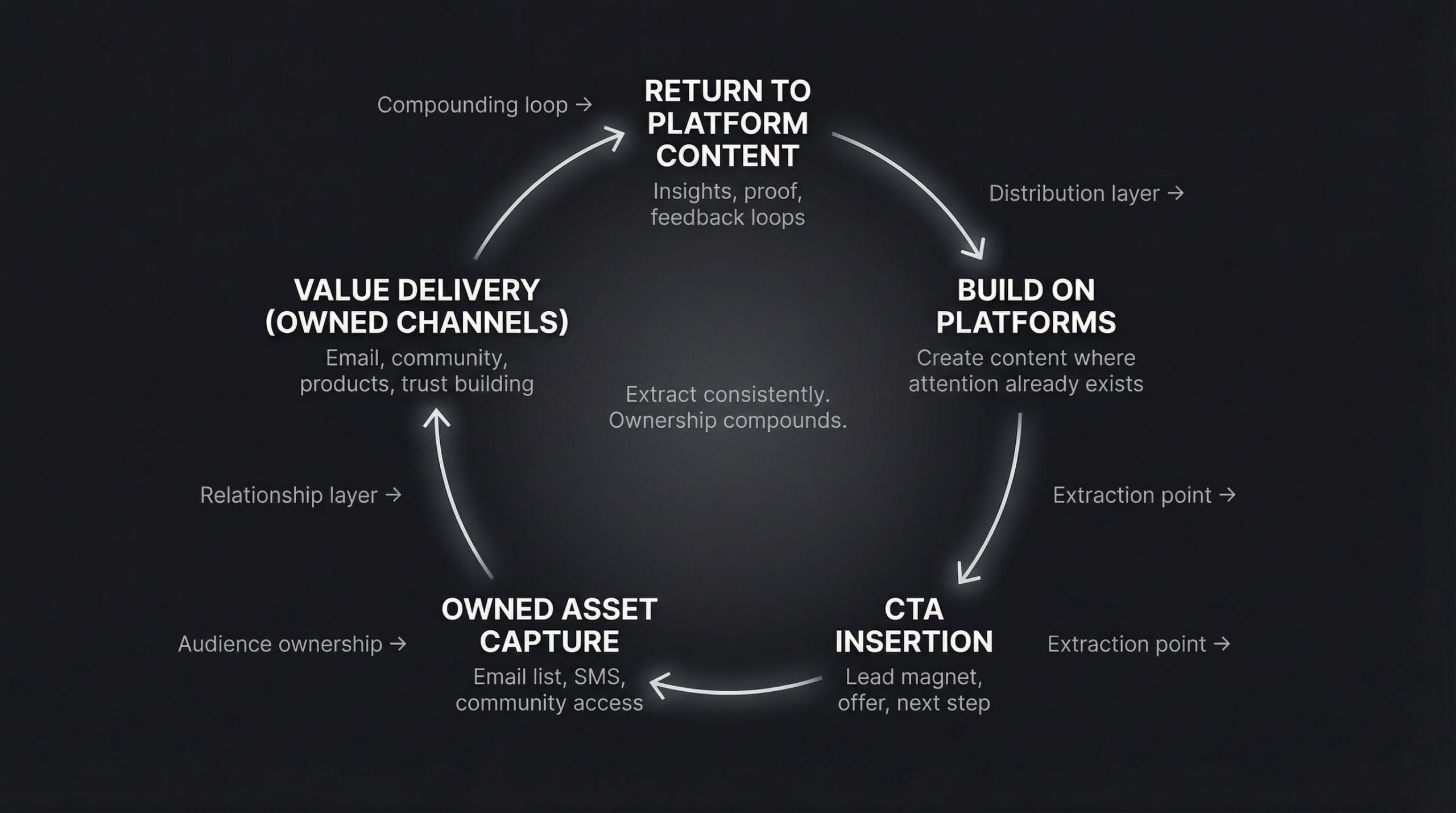
3. Build on platforms, extract value to owned assets
The extraction cycle:
- Use platform infrastructure for distribution and discovery
- Capture the resulting attention into channels you own
- Repeat continuously
The Resilience Test
Test your platform resilience quarterly by asking:
“If my primary platform banned me tomorrow, would my business survive?”
If the answer is no, or if you’d lose more than 50% of your income, you’re platform-dependent regardless of how many followers you have.
Platform independence is strategic risk management, not platform abandonment. You continue using platforms for what they do well: distribution at scale. But you build your actual business on assets you control.
Why Platform Dependency Is a Business Catastrophe (Not Just Inconvenient)
Platform dependency destroys creator businesses with predictable regularity. This isn’t rare or unlucky. It’s structural.
Real Catastrophes With Real Numbers
YouTube Demonetization Waves (2017-2018)
Thousands of channels lost monetization overnight. Creators with six-figure incomes watched revenue drop to $0 with no warning and no recourse.
Many never recovered because their entire business model depended on YouTube ad revenue. Those without owned audiences had no way to pivot.
Instagram Shadow Ban Epidemic (2022)
Accounts with 100,000+ followers saw reach drop by 95% with no explanation. No path to restoration. No human support.
Creators who spent years building audiences suddenly couldn’t reach them. Those without email lists had no way to maintain their community or income.
TikTok Shop Closure in Indonesia (2023)
TikTok shut down TikTok Shop, cutting off creators who built entire e-commerce businesses on the platform. Overnight loss of access to customers, orders, and revenue streams.
Those who had captured customer emails could rebuild elsewhere. Those who hadn’t, couldn’t.
Why This Keeps Happening
Platforms optimize for platform profit, not creator stability. Your interests and the platform’s interests are misaligned by design.
What benefits the platform:
- More time on site
- More engagement
- More ad impressions
What benefits creators:
- Stable reach
- Predictable revenue
- Creative freedom
These goals conflict.
The Rented Land Problem
You invest thousands of hours creating content, building an audience, and optimizing for platform-specific algorithms.
The platform owns all of it.
They can change terms unilaterally. You have no leverage and no recourse. Policy changes happen 1-2 times per year across major platforms.
The Hidden Psychological Cost
Platform dependency creates chronic anxiety about algorithm changes. Creative compromise to avoid content that might trigger demonetization. Policy self-censorship where you subconsciously avoid topics, words, or opinions that could get you banned.
Over 12-24 months, your content becomes generic, personality-stripped, and algorithmically safe but human-boring.
🚩 Here’s where most people mess this up: They recognize the risk but keep postponing action because “things are going well right now.” By the time the catastrophe hits, they’ve lost the leverage to build alternatives.
The Three Types of Platform Risk
| Risk Type | Description | Pattern |
|---|---|---|
| Policy Risk | Platform rules change in ways that harm your business | YouTube Partner Program revised in 2012, 2017, 2018, 2023 |
| Algorithm Risk | Your reach drops 50-90% overnight with no warning | Instagram killed chronological feeds in 2016, prioritized Reels in 2023 |
| Competitive Risk | Platform builds features that compete with creator businesses | TikTok Shop competes with creator e-commerce, Instagram Subscriptions competes with Patreon |
These three risks compound when combined. A policy change can trigger algorithm deprioritization, which makes it harder to compete with platform-native features.
Why “Diversifying Platforms” Isn’t Enough
Many creators respond to platform dependency by spreading content across YouTube, Instagram, TikTok, and Twitter.
This feels like diversification but it’s actually multiplication of dependency.
❌ The problem:
- Being on three platforms instead of one doesn’t reduce dependency if all three are rented assets
- You’ve tripled your workload and tripled your points of failure
- If any one platform changes policy or cuts your reach, you lose that audience completely
- You still own nothing
✅ True platform independence requires:
- Owned assets that persist regardless of which platforms succeed or fail
- Email lists, customer databases, products you host
- Direct relationships that don’t depend on any platform’s permission or infrastructure
Multi-platform presence is valuable for distribution. But without owned asset extraction, it’s just three different ways to be equally vulnerable.
The Owned vs Rented Asset Framework
The fundamental distinction in creator business architecture is between assets you control and assets platforms control.
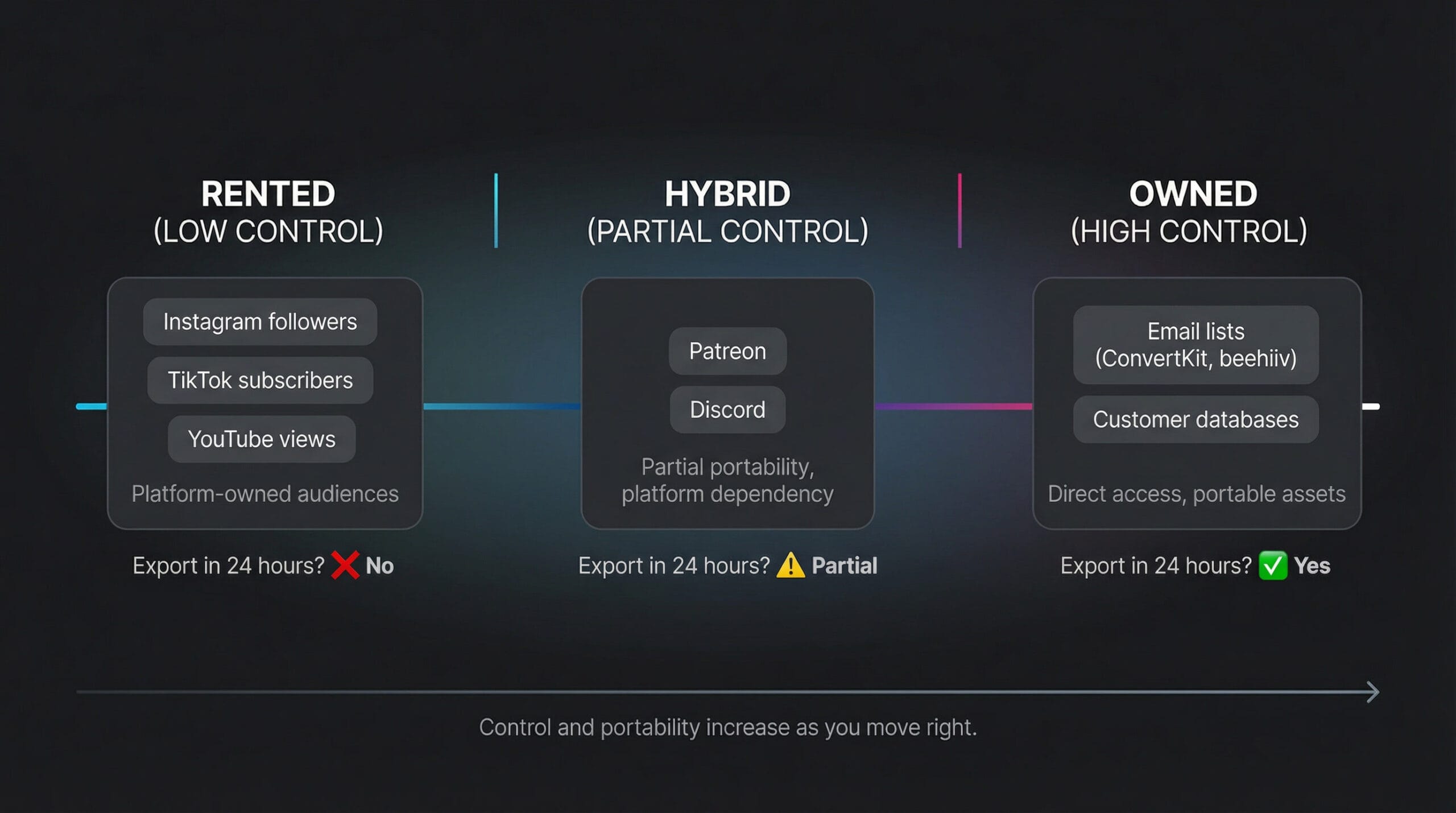
Understanding the Ownership Spectrum
Rented Assets = Access Without Control
You have access to these assets, but you don’t own them:
- Followers
- Subscribers
- Views
- Algorithmic reach
The platform can remove your access at any time for any reason.
Rented assets live on infrastructure you don’t control, under terms you didn’t negotiate, which can change without your consent.
Owned Assets = Full Control
You own these assets completely. No platform can remove them:
- Email lists
- Customer databases
- Products you host
- Content libraries you control
- Direct relationships
They persist regardless of policy changes, algorithm shifts, or platform shutdowns. Owned assets can be exported, moved, and rebuilt on different infrastructure.
The Minimum Viable Owned Asset
Email is the baseline because it can’t be taken, can’t be throttled, and remains portable forever.
If you have someone’s email address, you can contact them regardless of what happens to any platform. Email addresses work across all infrastructure. They’re platform-independent by design. No platform intermediation required.
The Ownership Test
Ask yourself: “Can the platform remove my access to this asset without my permission?”
- If yes, it’s rented
- If no, it’s owned
The 10,000 Follower Trap
Large follower counts create a false sense of business security.
10,000 Instagram followers feels significant. It represents real people who chose to follow you.
But here’s what happens if Instagram bans your account or shadow bans your content: Those 10,000 followers become immediately inaccessible.
❌ Without their email addresses:
- You have zero ability to reach them
- You can’t tell them you moved to a different platform
- You can’t offer them products
- You can’t maintain the relationship
The follower count was always an illusion of ownership.
🚩 This trap is especially dangerous because it creates complacency. Creators see growing follower counts and assume their business is growing. They delay building owned assets because they feel like they already have an audience.
By the time they realize followers aren’t owned, they’ve lost the leverage to convert them.
Think of it this way: Followers are leads, not assets. They’re potential members of your owned audience. Until you capture their email or direct contact, they remain rented access that the platform controls.
What Counts as “Owned” (and What Doesn’t)
The ownership spectrum includes gray areas that confuse creators about what they actually control.
| Platform | Ownership Level | Export Process | Verdict |
|---|---|---|---|
| Substack | ✅ Fully Owned | Clean CSV export, 15 minutes to migrate | Can rebuild newsletter anywhere |
| ConvertKit/beehiiv | ✅ Fully Owned | Designed for portability, full export in <24 hours | True ownership by design |
| Patreon | ⚠️ Hybrid | Email export exists but requires 2-4 hours of data cleaning | Technically accessible, limited portability |
| Discord | ❌ Not Owned | No native email export, requires bots/hacks that violate ToS | Platform bans = complete loss |
The Critical Test: Exportability and Portability
“Can I export my full audience with contact information and move to a different platform tomorrow?”
- If yes, it’s owned
- If no or requires significant friction, it’s rented or hybrid
🚩 Just because a platform calls itself “creator-first” doesn’t mean you own the audience. Test exportability, not marketing promises.
How to Extract Value From Platforms Into Owned Assets
Platform independence isn’t built by abandoning platforms. It’s built by systematically extracting value from platform infrastructure into owned channels.
The Extraction Funnel
The cycle that compounds over time:
1. Create content on platforms to reach new people through free distribution
2. Include calls to action that move a percentage of viewers to owned channels
3. Deliver value through owned channels to strengthen the direct relationship
4. Repeat continuously to compound owned audience growth
The 1-5% Conversion Target
Every piece of platform content should move 1-5% of viewers to owned assets.
This seems like a low percentage, but it compounds rapidly.
Here’s the math:
- You post 3 times per week
- Each post reaches 1,000 people
- That’s 3,000 impressions per week
- At 2% conversion, that’s 60 new email subscribers per week
- Or 3,120 per year
Most creators get zero because they never ask.
Platform-Specific Extraction Tactics
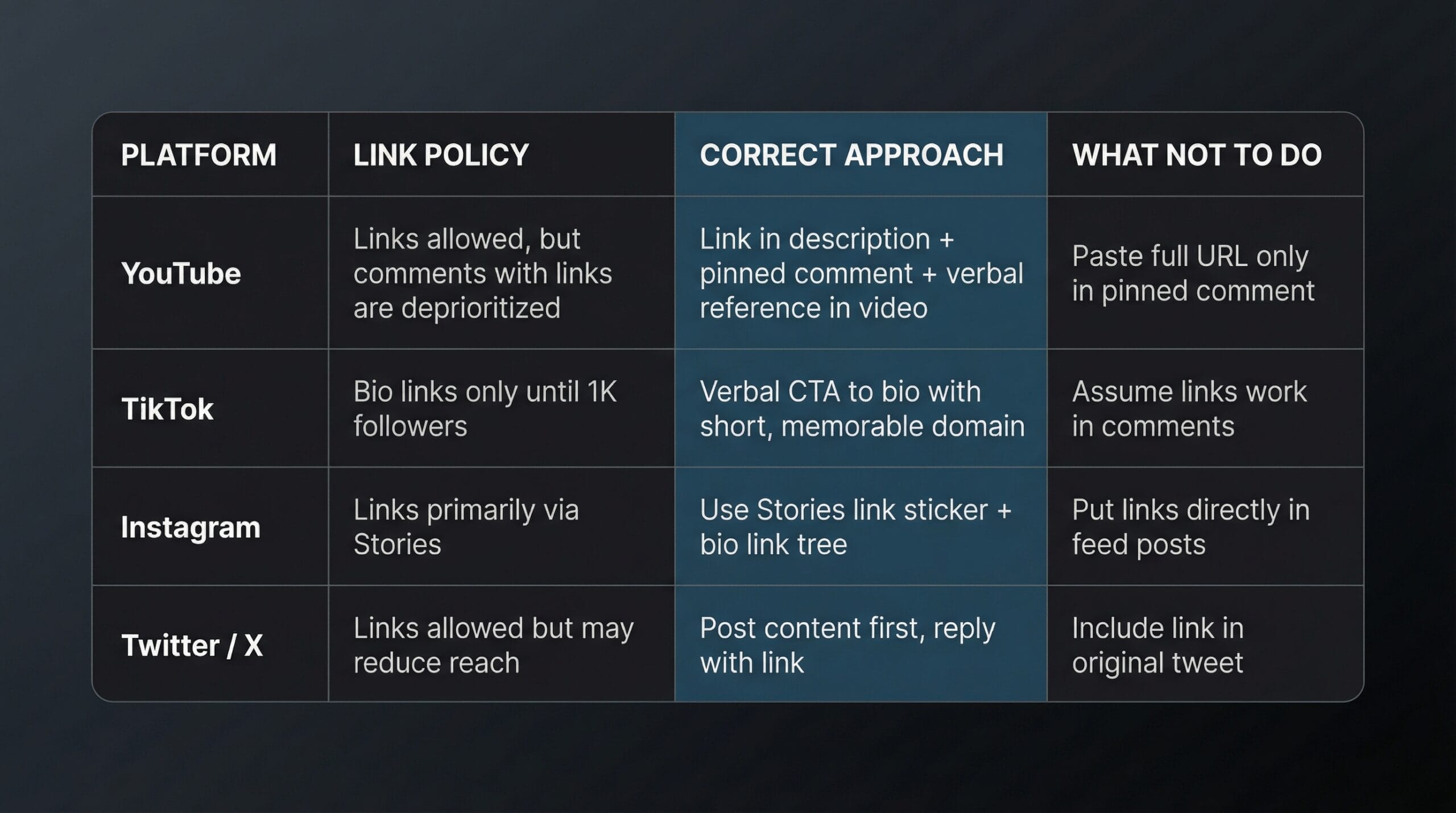
Each platform has different link restrictions and user behaviors. What works on one platform fails on another.
YouTube
Link policy: Links allowed in video descriptions and pinned comments, but comments with links get algorithmically deprioritized.
✅ The correct approach:
- Put the link in your description
- Create a pinned comment that verbally references it without including the clickable link
- Say: “Full resource in the description below”
- Don’t paste the URL in the comment
TikTok
Link policy: Links restricted to bio only until you reach 1,000 followers.
✅ Before 1K followers:
- Use verbal calls to action
- Direct people to your bio
- Use a memorable branded short domain they can type manually
✅ After 1K followers:
- Add link stickers to your videos
- Continue using bio links as backup
Link policy: No clickable links in posts or comments. Stories are the only place where link stickers work.
✅ The correct approach:
- Put your main CTA in Stories with the link sticker
- Reference it in your feed posts and Reels
- Use a bio link tree for multiple destinations
Twitter/X
Link policy: Links allowed in tweets but they reduce reach.
✅ The workaround:
- Post your main content first
- Let it gain engagement momentum
- Reply to your own tweet with the link
This separates the reach-optimized content from the link that would throttle it.
Lead Magnets That Actually Convert Platform Audiences
Not all lead magnets convert platform audiences at the same rate. Conversion hierarchy matters.
| Lead Magnet Type | Conversion Rate | Why It Works |
|---|---|---|
| Swipe files & templates | 8-15% | Immediate utility (people can use them today) |
| Toolkits & checklists | 5-10% | Clear frameworks, step-by-step guidance |
| PDF guides | 2-5% | Educational value but requires time investment |
| Generic “newsletter signup” | <1% | Vague promise, no specific value |
Examples of High-Converting Lead Magnets
✅ Swipe files & templates:
- Email templates
- Content calendars
- Design files
- Spreadsheet calculators
✅ Toolkits & checklists:
- Launch checklists
- Setup guides
- Resource lists
❌ Low-converting offers:
- “Sign up for weekly tips”
- “Join my newsletter”
- “Get updates”
My take on this: Immediate utility beats educational content every time. If you want to convert platform audiences to owned assets, create lead magnets that provide value within 5 minutes of download. Stop offering vague promises.
How to Promote Owned Assets Without Violating Platform Rules
Platform policies restrict self-promotion because platforms want to keep users on their infrastructure. This creates tension between extraction and compliance.
The key: Frame owned asset promotion as value delivery, not self-promotion.
Bad vs Good CTA Examples
❌ Bad: “Sign up for my newsletter”
✅ Good: “I created a free template that solves this exact problem. Link in bio”
The good version positions the owned asset as additional value, not a marketing funnel.
Making CTAs Feel Natural
If your platform content teaches a concept, your lead magnet should be the tool that implements that concept. If your content shows a problem, your lead magnet should be the solution.
The owned asset should feel like a completion of the value you started on the platform.
Strategic CTA Timing
Platform-specific timing for maximum conversion:
| Platform | Optimal CTA Timing |
|---|---|
| YouTube | 2-minute mark (engaged but not committed to full video) |
| TikTok | First 3 seconds + repeat at end |
| Use “swipe up” language in Stories to create urgency |
Testing CTA Intensity
Soft CTAs (for established creators with trust):
- “If you want to go deeper, I have a free resource in my bio”
Direct CTAs (for newer creators who need to be explicit):
- “Download the free template to implement this today”
Make extraction systematic without triggering platform suppression. You’re not breaking rules. You’re providing additional value that happens to live on infrastructure you control.
Common Mistakes That Keep Creators Platform-Dependent
Most creators who fail to achieve platform independence make one of five predictable mistakes.
Mistake #1: Waiting Until They “Need” Platform Independence
❌ The problem: Waiting until after a catastrophe (a ban, demonetization, or reach drop).
By that point, leverage is gone.
When your reach is cut by 90%, you can’t effectively promote a lead magnet to rebuild on owned channels. You needed the owned audience BEFORE the catastrophe, not after.
✅ The correct approach:
Build owned assets from day one.
- If you have 100 followers, capture 10 emails
- If you have 1,000 followers, capture 100 emails
The ratio matters more than the absolute number. Starting early creates the habit and infrastructure you’ll need at scale.
Mistake #2: Treating Email Collection as a Side Project
❌ The problem: Most creators track follower growth, view counts, and engagement rates obsessively. Email list growth is an afterthought checked monthly if at all.
✅ Email capture rate should be your most important metric:
How many new email subscribers do you gain per 1,000 platform followers or per 10,000 views?
If you don’t know this number or aren’t actively working to improve it, you’re treating owned assets as secondary. They should be primary.
Mistake #3: Building Owned Assets That Mimic Platform Logic
❌ The problem: Creators replicate the chaos of platform environments in their owned channels.
They send daily emails with engagement bait subject lines, algorithm-optimized content, and the same content treadmill pressure that burned them out on platforms.
The result: Owned assets feel as exhausting and unsustainable as platform content. Subscribers unsubscribe at high rates because they signed up for something different and got more of the same.
✅ The correct approach:
Owned channels should be differentiated by being calmer, deeper, less frequent, and higher value.
The point of owning the channel is to escape platform constraints. Use that freedom to create something sustainable that can’t exist on platforms.
Mistake #4: Abandoning Platforms Entirely
❌ The problem: Some creators hear “platform independence” and interpret it as “delete all social media.”
This throws away the primary benefit of platforms: free distribution at scale.
✅ The correct model is extraction, not abandonment:
Continue using platforms for what they do well (reaching new people). Ensure you’re systematically capturing that attention into channels you control.
Build on their infrastructure, extract to yours, repeat.
Mistake #5: No Ownership Documentation
❌ The problem: Most creators store all platform credentials in one person’s brain or one unlocked device.
Catastrophe scenario: If that person gets sick, dies, or loses the device, the entire business becomes inaccessible.
✅ The correct approach:
- Use a password manager with emergency access designee
- Export all platform data to an external hard drive annually
- Document what accounts exist, who has access, and how to recover them
Platform independence requires operational resilience, not just audience resilience.
The 90-Day Platform Independence Roadmap
Platform independence is built systematically over 90 days, not achieved overnight through panic or scrambling.
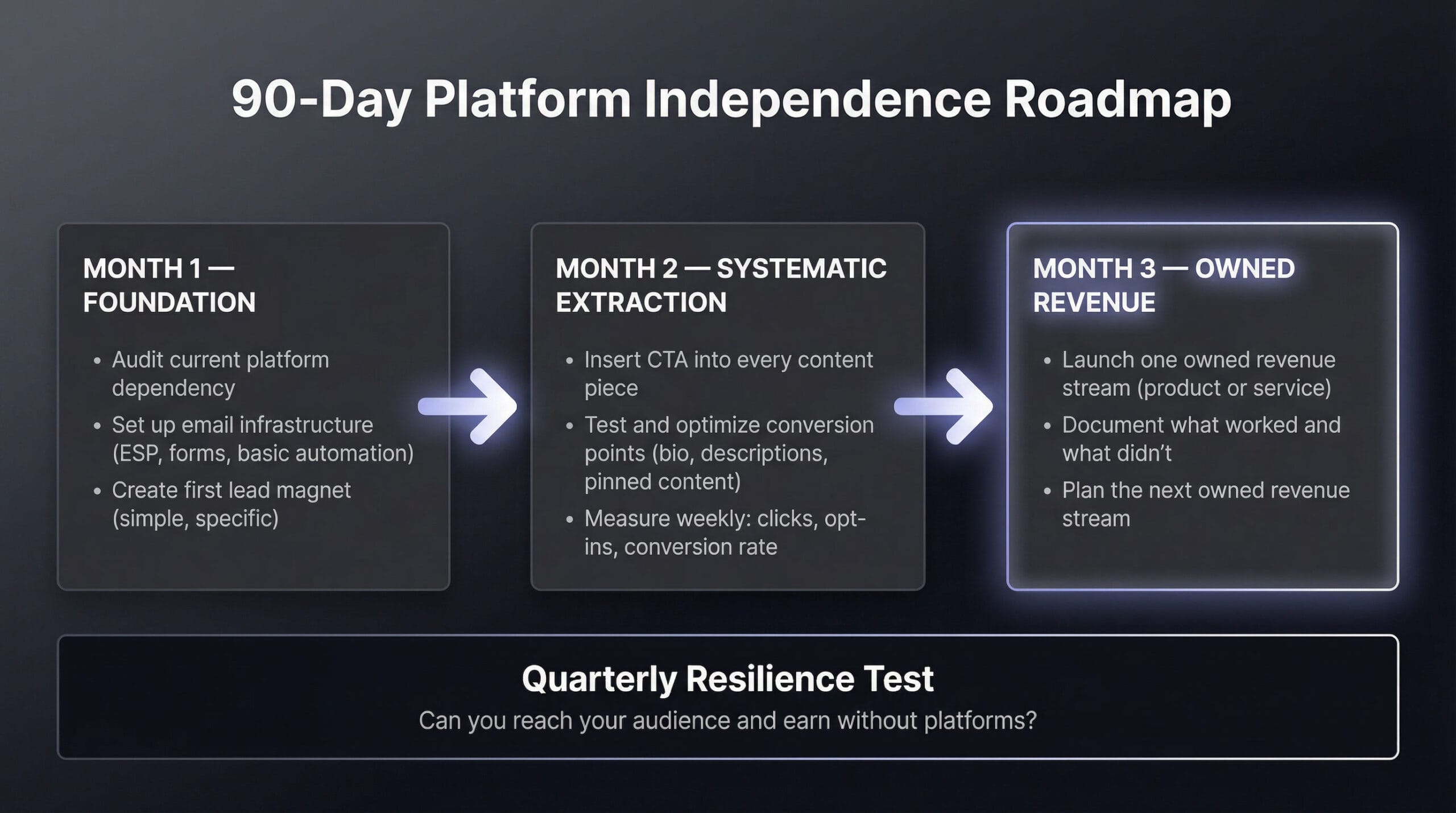
Month 1: Foundation
Objective: Understand current dependency and establish owned infrastructure.
Actions to take:
1. Audit your current dependency
Calculate what percentage of your income comes from each source.
🚩 Red flag: If any single platform represents more than 50% of total income, you’re platform-dependent.
2. Set up email infrastructure
Use platforms with full exportability:
- ConvertKit
- beehiiv
- Buttondown
❌ Avoid: Platforms without clean CSV export.
3. Create your first lead magnet
Use the conversion hierarchy. Prioritize templates or toolkits over PDFs.
Design it to solve the single most common problem your audience faces.
Month 2: Systematic Extraction
Objective: Make owned asset extraction automatic and consistent.
Actions to take:
1. Add a CTA to every piece of content
Every video, post, Story, or tweet should include one clear prompt to claim your lead magnet.
Pin comments. Update bios. Use link stickers. Reference your owned asset consistently.
2. Test different CTA wording and placement
Optimize conversion rate through experimentation.
Your goal: Identify a repeatable formula that moves 1-5% of platform audience to owned channels.
3. Measure weekly
Track:
- New email subscribers per week
- Conversion rate per 1,000 platform followers
- Which CTAs perform best
Month 3: Owned Revenue
Objective: Prove you can generate income without platform intermediation.
Actions to take:
1. Launch one owned revenue stream
Options:
- Digital product
- Paid community
- Membership
- Consulting service
- Direct offering
The revenue doesn’t need to be significant yet. The goal is to prove you can generate income without platform intermediation.
Even $100 of direct revenue validates the model and provides a foundation to scale.
2. Document what worked
- What product format converted best?
- What price point felt right?
- What delivery method was sustainable?
3. Plan next revenue stream
Don’t stop at one. Build toward 3-5 owned revenue sources within 12 months.
After 90 Days: Measure Your Progress
Use three metrics to track platform independence:
| Metric | Formula | Target |
|---|---|---|
| Owned Contact % | Email subscribers ÷ Platform followers | 5-10% minimum, 15-25% ideal |
| Direct Revenue % | Owned channel income ÷ Total income | 10-20% in year one, 50%+ in year two |
| Platform Concentration | Largest single income source ÷ Total income | Under 50% (under 40% is safer) |
The Quarterly Resilience Test
Every 3 months, ask yourself:
“If my primary platform banned me tomorrow, could my business survive?”
Answer honestly.
If you’d lose more than 50% of income, you’re still platform-dependent. If you couldn’t reach your audience, you’re still platform-dependent.
Adjust your extraction and diversification accordingly.
When You Should Stay Platform-Dependent (Yes, Really)
Platform independence isn’t always the right strategy in every situation at every stage.
Scenarios Where Full Independence Can Wait
✅ Pre-monetization with under 1,000 followers
Focus on creating great content and building initial audience before optimizing extraction. You need something to extract first.
Basic email capture is still valuable, but don’t let owned asset building distract from the core work of making content people want.
✅ Rapid growth phase where algorithm favor is high
Lean into platform-native monetization before diversifying.
When reach is spiking and ad revenue is flowing, capture that momentum. You can extract value to owned channels simultaneously, but don’t abandon what’s working in pursuit of theoretical independence.
✅ Your business model is platform arbitrage
If you’re built to exploit specific platform mechanics or policies, you’re choosing platform dependency as a conscious strategy.
This is acceptable if you understand and accept the risk.
Some creators make seven figures from TikTok Shop or YouTube ad revenue by being platform-native. That’s a legitimate choice as long as it’s deliberate, not default.
The key is intentionality. Choosing platform dependency with full awareness of risks is different from unconsciously defaulting to it because you never considered alternatives.
How to Measure Platform Independence Progress
Platform independence requires concrete metrics, not abstract goals.
The Three Critical Metrics
1. Owned Contact Percentage
Formula: Email subscribers ÷ Total platform followers
Example: If you have 10,000 Instagram followers and 500 email subscribers, your owned contact percentage is 5%.
Targets:
- Minimum: 5-10%
- Ideal: 15-25%
This reveals whether your audience is truly yours or just borrowed from platforms.
2. Direct Revenue Percentage
Formula: Income from owned channels ÷ Total income
Example: If you earn $5,000/month and $1,000 comes from digital products you sell directly while $4,000 comes from YouTube ad revenue, your direct revenue percentage is 20%.
Targets:
- Year one: 10-20%
- Year two: 30-50%
- Year three: 50%+ for true independence
3. Platform Concentration Risk Score
Formula: Largest single income source ÷ Total income
Example: If YouTube represents $8,000 of your $10,000 monthly income, your concentration score is 80%.
🚩 This is catastrophically high.
Targets:
- Maximum: Under 50% from any single source
- Safer: Under 40%
- Highly resilient: Under 30%
The implementation rule: Measure these quarterly. If metrics aren’t improving, your extraction systems aren’t working and need adjustment.
Platform independence is measurable or it doesn’t exist.
Final Thoughts
Platform independence isn’t about rejecting platforms or dismissing their value.
Platforms provide distribution, discovery, and infrastructure that would be impossible to replicate independently. They’re essential tools for reaching new audiences at scale.
But building your entire business on rented land is a voluntary catastrophe waiting to happen.
Policy changes, algorithm shifts, and platform competition are predictable patterns that repeat across every platform every few years.
Treating these as anomalies instead of structural realities is strategic negligence.
The Path Forward
Use platforms for what they do well: Distribution.
Build your actual business on assets you control: Email lists, customer relationships, owned products.
Measure progress: Owned contact %, direct revenue %, platform concentration risk.
Test resilience quarterly: “Could my business survive if my primary platform disappeared tomorrow?”
Start Now, Not After Catastrophe
By then, leverage is gone.
- If you have 100 followers today, capture 10 emails
- If you have 10,000 followers, capture 1,000 emails
The ratio matters more than the absolute number.
Build the habit and infrastructure now so it’s ready when you need it.
Platform Dependency Is a Choice
Platform dependency is a choice, not a requirement.
Most creators choose it by default because they never considered alternatives.
You now have the framework to choose differently.
Your Next Step
If you found this valuable, the natural next step is implementation.
Pick one action this month:
✅ Build one owned asset
✅ Create one lead magnet
✅ Add one systematic CTA to your content
✅ Measure one metric
Progress compounds through consistent small actions, not dramatic overhauls.
If this feels overwhelming, focus on just one thing: start capturing emails today. Everything else can wait, but that single action protects everything you’ve already built.